

Addiction, Dopamine, Anhedonia, and the Question: Is Life Still Worth Living?
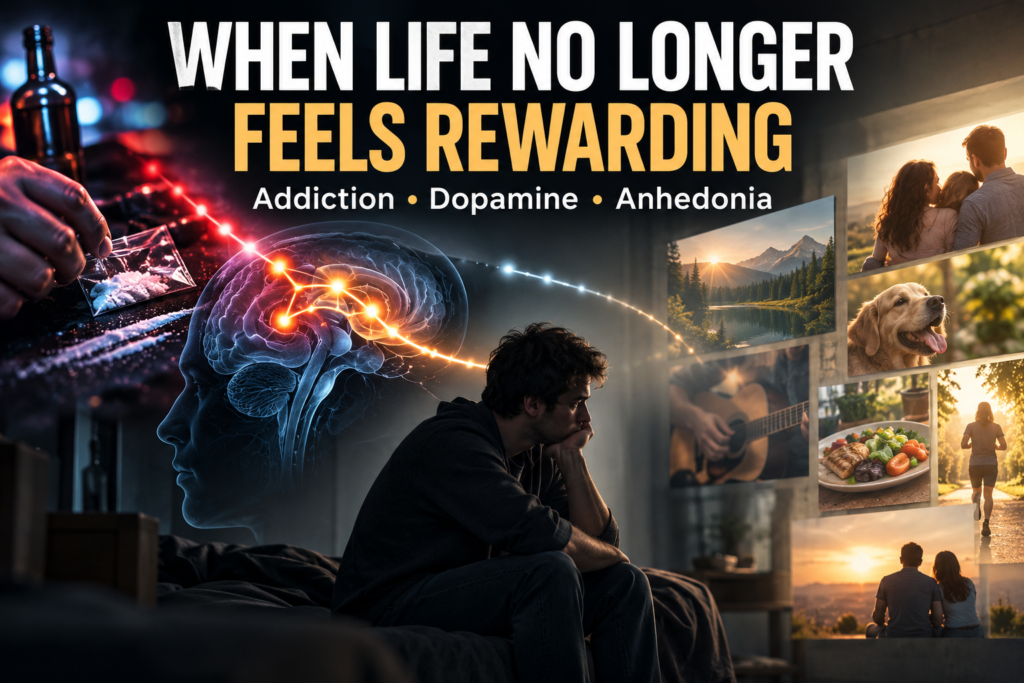
What happens when the things that once made life enjoyable no longer make you feel much of anything?
Food still tastes like food. Your family still loves you. The sun still rises. Music still plays. You may have friends, opportunities, relationships, and a future.
Yet something has changed.
You no longer anticipate these experiences with excitement. You don’t feel motivated to pursue them. Things that once mattered begin to feel strangely empty.
There is a word for this loss of pleasure and interest: anhedonia.
And I believe understanding anhedonia may help us ask a difficult question about addiction that receives far too little attention:
Can repeatedly exposing the brain to extraordinarily powerful rewards eventually make ordinary life feel less rewarding?
And if it can, what happens when life itself begins to lose its ability to motivate us?
A Tragedy That Raises Difficult Questions
In September 2026, Presley Gerber, the 27-year-old son of Cindy Crawford and Rande Gerber, died at a rehabilitation facility. At the time of writing, the Los Angeles Medical Examiner had not publicly disclosed an official cause of death. Gerber had previously spoken publicly about mental health struggles.
I am not presenting Gerber’s death as a suicide. We don’t have evidence establishing that.
His story raises a different question.
From the outside, Gerber seemed to possess many of the things society tells young people should make them happy. He was handsome, a successful model, born into an affluent and famous family, and surrounded by opportunities most people will never experience.
Yet external circumstances don’t tell us how rewarding life feels from inside someone’s brain.
And that distinction matters.
Suicide Remains a Major Problem Among Young Americans
We should also be precise about the statistics.
Suicide rates are not currently exploding among every group of young Americans. In fact, the latest CDC data show declines from 2023 to 2024 among males ages 15 to 24 and 25 to 44.
But the larger picture remains disturbing.
In 2024, suicide was the second leading cause of death among Americans ages 10 to 44. Nearly 49,000 Americans died by suicide that year.
Why can life become so unbearable that a human being no longer wants to continue living?
There will never be one answer.
But addiction forces us to examine one possibility that deserves much more attention: what happens to our ability to experience reward?
Dopamine Is Not Simply the “Pleasure Chemical”
Dopamine is often described as the brain’s pleasure chemical.
That’s an oversimplification.
Dopamine is deeply involved in reinforcement, motivation, learning, and teaching the brain that something important has happened and should be pursued again.
Natural rewards activate this system.
Eating.
Social interaction.
Music.
Achievement.
Sex.
Exercise.
Affection.
These experiences help teach the brain what is worth pursuing.
Addictive drugs, nicotine, and ultra-processed food can interfere with this ancient biological system.
The National Institute on Drug Abuse explains that drugs can produce neurotransmitter surges much greater than the smaller bursts associated with healthy rewards. Large dopamine surges can powerfully reinforce the association between the drug, its effects, and the environmental cues surrounding its use.
In other words, the brain learns:
This matters. Do it again.
And again.
And again.
When Extraordinary Reward Competes With Ordinary Life
This is where addiction becomes much more interesting than the simplistic idea that someone just enjoys getting high.
The brain adapts.
Older NIDA educational material described how repeated drug use can lead the brain to compensate for overwhelming dopamine signaling by reducing dopamine production or receptor availability, decreasing the impact of dopamine within reward circuitry.
But I would not describe this simply as “low dopamine.”
The brain isn’t a gasoline tank that becomes empty.
Addiction involves changes across multiple brain systems involving reward, motivation, learning, stress, impulse control, memory, and other neurotransmitters.
The important point is dysregulation.
Repeated exposure to unusually powerful rewards can change how the brain responds to both the drug and ordinary experiences.
NIDA has described repeated drug-induced dopamine surges as ultimately blunting the dopamine system’s response to everyday stimuli and disturbing the normal hierarchy of needs and desires.
Think about the implications.
The family hasn’t changed.
The sunset hasn’t changed.
Music hasn’t changed.
A walk through nature hasn’t changed.
But the brain experiencing them may have.
When Nothing Feels Good Anymore
This brings us to anhedonia.
Anhedonia isn’t merely sadness.
A person can understand intellectually that something should be enjoyable while experiencing little desire or pleasure from it.
Researchers describe different dimensions of anhedonia. Someone can have difficulty anticipating pleasure, experiencing pleasure, or becoming motivated enough to pursue something that previously mattered.
Now consider that experience in the context of addiction.
At first, a person may use a substance because:
It makes me feel incredible.
Later:
I need it to feel good.
And eventually:
I need it just to feel normal.
Meanwhile, ordinary rewards may increasingly struggle to compete.
This creates one of addiction’s cruelest paradoxes:
The substance initially used to make life feel better may eventually contribute to a life that feels worse without it.
Anhedonia and Suicide
This is where the subject becomes much more serious.
A scientific review examined 22 studies investigating anhedonia and suicidal behavior. The overall literature was not perfectly consistent, something we should not hide.
But the researchers found particularly consistent associations in affective disorders, where all seven included studies reported a significant positive association, and PTSD, where all three did. The association was more consistent for suicidal ideation than for suicide attempts or completed suicide.
One study discussed in that review found that anhedonia was associated with suicidal ideation and that reductions in anhedonia were associated with reductions in suicidal thoughts, even beyond changes in other depressive symptoms.
Another study found that loss of interest became particularly intense in the months preceding suicidal behavior among people with bipolar disorder.
Other research described in the review found relationships among anhedonia, feelings of entrapment, and the severity of suicidal thinking.
None of this proves:
Low dopamine causes suicide.
And it certainly doesn’t prove:
Drug use causes every suicide.
But it raises a question we should not ignore.
What If Life Can Lose Its Reward Value?
Imagine waking up every morning and feeling no anticipation.
The people you love don’t excite you.
Food doesn’t interest you.
Your hobbies seem pointless.
Accomplishments bring little satisfaction.
You don’t look forward to tomorrow because you cannot imagine tomorrow feeling substantially different from today.
Now the question “Is life worth living?” takes on a different meaning.
It isn’t merely philosophical.
For someone experiencing profound anhedonia, it may reflect an inability to experience the rewards that normally give life emotional value.
The CDC emphasizes that suicide has many interacting risk and protective factors. Mental health conditions, social circumstances, relationships, access to care, and other factors matter. About half of people who die by suicide have a history of a known diagnosed mental health condition, while about half do not have one known at the time of death.
So I am not proposing dopamine as a universal explanation for suicide.
I am asking whether reward dysfunction deserves a much larger place in the conversation.
Addiction Is Not Just About Wanting the Drug
This changes how we should think about addiction.
We tend to focus on the substance.
“Why doesn’t he stop drinking?”
“Why doesn’t she stop using?”
“Why can’t he just quit?”
But addiction may eventually become about much more than wanting the substance.
The person’s motivational world may have changed.
The drug can become disproportionately important while healthier rewards become less motivating.
That’s one reason telling someone to “just stop” profoundly misunderstands addiction.
Remove the drug, and what remains?
If ordinary life immediately felt wonderful again, recovery would be considerably easier.
But for some people, recovery involves learning to live while the reward system is recovering too.
That can mean tolerating periods when normal life doesn’t yet feel sufficiently rewarding.
And that is precisely when support, purpose, relationships, structure, and understanding become so important.
The Most Dangerous Stage May Not Be the High
We understandably concentrate on intoxication and overdose.
But perhaps we should also pay much more attention to what happens between the highs.
The emptiness.
The inability to enjoy normal activities.
The loss of motivation.
The sense that nothing is exciting anymore.
The belief that the drug is the only thing capable of changing how you feel.
That is not freedom.
It is enslavement.
The person may have begun using a substance in pursuit of pleasure but eventually find that the substance has acquired extraordinary power over what feels valuable.
The Brain Can Change, But That Works Both Ways
There is an important reason not to end this discussion in despair.
The same capacity of the brain to adapt to repeated drug exposure also means the brain is not necessarily permanently frozen in that state.
Recovery can take time.
Pleasure may not return immediately.
Motivation may not return immediately.
Life may initially feel flat without the substance that repeatedly produced an intense reward.
Understanding this matters because someone in early recovery may mistakenly interpret that temporary state as:
“This is what life without drugs will always feel like.”
It may not be.
And that knowledge could be enormously important.
Maybe We Have Been Asking the Wrong Question
We often ask:
Why would someone destroy their life for a drug?
Perhaps sometimes we should reverse the question:
What did repeated drug use do to the person’s experience of life?
Addiction isn’t simply a battle between intelligence and stupidity, strength and weakness, or good decisions and bad decisions.
It can involve changes in the very biological systems that tell us what matters, what deserves our attention, and what is worth pursuing.
And that brings us back to the question we started with.
What happens when ordinary life no longer feels rewarding?
We don’t yet have evidence to say that dopamine dysregulation or anhedonia explains suicide generally.
But we have enough evidence to take the relationship among addiction, reward dysfunction, anhedonia, and suicidal thinking seriously.
Perhaps one of the most destructive consequences of addiction isn’t simply what the substance does while you’re using it.
It’s what ordinary life can feel like when you’re not.
Breaking the Chains
This is one of the reasons I wrote Unshackled: Breaking Free from Addiction and Emotional Slavery.
Addiction isn’t only about stopping a substance. It is about understanding why that substance became so important, recognizing the triggers and rewards that keep pulling you back, and learning how to reclaim a life that no longer revolves around the next high, drink, cigarette, food, or escape.
If addiction has taken control of what makes life feel rewarding, recovery must ultimately be about more than abstinence.
It must be about reclaiming your life.