

Part 2
If you haven’t read the first part of the article, please read it here.
What If Obesity Is More Than a Nutritional Problem?
We’ve spent decades looking at obesity primarily as a nutritional problem.
Eat fewer calories.
Exercise more.
Avoid sugar.
Eat more vegetables.
While all of that is good advice, it overlooks one important question:
Why do so many people keep returning to foods they already know are harming them?
If knowledge alone changed behavior, obesity rates would be falling instead of rising.
Perhaps we’re asking the wrong question.
Instead of asking, “Why do people eat unhealthy foods?” perhaps we should ask:
“Why is it so difficult for millions of people to stop?”
That question takes us beyond nutrition and into food addiction and behavior.
Addiction Doesn’t Begin With Weakness
One of the biggest misconceptions about addiction is that it reflects a lack of character or self-control.
I don’t believe that’s true.
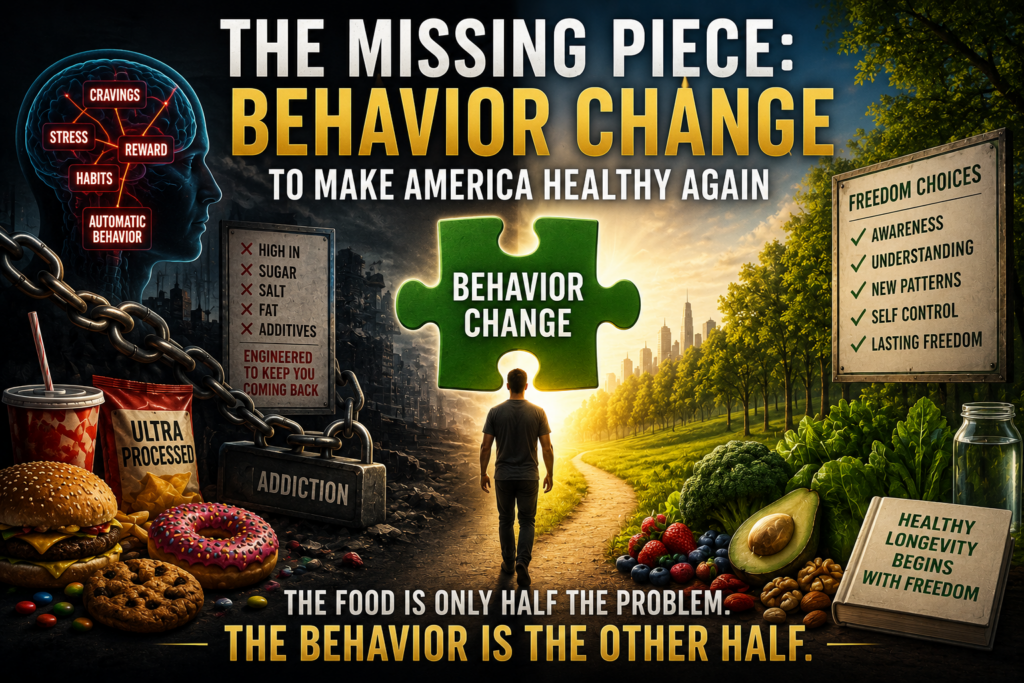
I believe addiction develops when a behavior is repeated so many times that it becomes automatic.
Think about how often people eat.
Three meals a day.
Snacks between meals.
Celebrations.
Birthdays.
Vacations.
Stressful days.
Lonely evenings.
Over months and years, certain foods become connected to comfort, reward, relaxation, and emotional relief.
Eventually, reaching for those foods requires very little conscious thought.
The behavior has become automatic.
That’s why telling someone to “just stop eating junk food” often produces frustration rather than success.
They’re not simply fighting food.
They’re trying to interrupt a pattern their brain has practiced thousands of times.
The Missing Link Between MAHA and Healthy America
Imagine the MAHA movement succeeds.
Food manufacturers remove many harmful ingredients.
Ultra-processed foods become healthier.
Schools serve more nutritious meals.
Americans have better choices everywhere they go.
That would be an extraordinary achievement.
But would everyone suddenly begin choosing those healthier foods?
History suggests otherwise.
Changing the environment makes healthy choices easier.
It doesn’t automatically change the habits people have built over years or decades.
The smoker still reaches for a cigarette.
The emotional eater still opens the pantry after a stressful day.
The person who associates dessert with comfort still craves something sweet after dinner.
The environment may improve.
But unless behavior changes, many people will continue struggling.
That’s why I believe the MAHA movement addresses one side of the problem.
My work focuses on the other.
You Cannot Scare Someone Out of Addiction
For decades, cigarette packs have carried warning labels.
Smokers know the risks.
Many watched family members suffer from smoking-related diseases.
Yet millions continued smoking.
Fear alone rarely breaks addiction.
The same principle applies to unhealthy eating.
People don’t need another lecture telling them obesity increases the risk of disease.
Most already know.
They don’t need another article explaining that ultra-processed foods are unhealthy.
Most already know that too.
What many people need is help breaking the automatic behaviors that keep pulling them back.
Knowledge creates awareness.
Behavior creates change.
Without changing behavior, awareness often becomes frustration.
Breaking the Chain
This realization changed the direction of my work.
For years, my focus was helping people achieve healthy longevity.
But eventually I realized something.
Many people would never reach that goal unless they first broke free from the addictions and unhealthy behaviors preventing them from getting there.
That’s why I created an addiction recovery system.
Not because food is the only addiction.
And not because I believe everyone struggling with obesity is addicted.
But because millions of people are trapped in behavioral patterns they desperately want to escape.
My approach isn’t about fighting your subconscious mind.
It’s about working with it.
Instead of relying entirely on willpower, I teach practical strategies that help people interrupt automatic behaviors before they become automatic actions.
Recovery isn’t about becoming stronger than your addiction.
It’s about understanding what has been controlling your behavior and learning how to take back that control.
Healthy Longevity Begins With Freedom
Healthy longevity isn’t simply about living longer.
It’s about remaining healthy, active, independent, and mentally sharp throughout the years you’ve been given.