


Part 1
The Make America Healthy Again (MAHA) movement has sparked one of the most important conversations about health in decades. Americans are finally asking questions that should have been asked years ago.
Why are chronic diseases becoming more common?
Why are more than 70% of American adults overweight or obese?
Why are children developing diseases that were once seen almost exclusively in adults?
Why are so many people taking prescription medications simply to manage conditions that might have been prevented?
The MAHA movement deserves credit for bringing these questions into the spotlight. It has challenged the widespread use of ultra-processed foods, artificial ingredients, excessive sugar, and other products that have become staples of the modern American diet. It has encouraged millions of people to think differently about what they put into their bodies.
I agree with much of that message.
As someone who has spent nearly three decades studying, researching, practicing, and coaching people toward healthy longevity, I believe we must improve the quality of the food Americans eat. We cannot expect people to become healthier if the foods surrounding them every day continue to work against them.
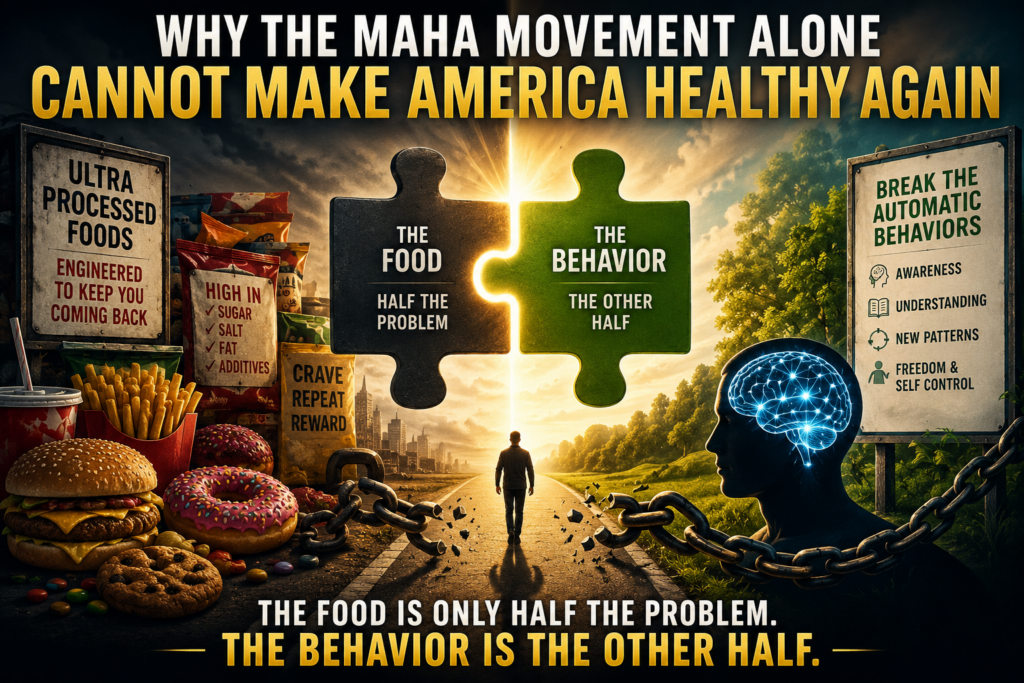
But I also believe the MAHA movement is missing one essential piece of the puzzle to fight food addiction.
And without that missing piece, I don’t believe America will become healthy again.
We Already Know What Makes Us Sick
Let’s be honest.
Most Americans already know that smoking is dangerous.
Most know that obesity increases the risk of diabetes, heart disease, stroke, and certain cancers.
Most know that drinking sugary beverages every day isn’t healthy.
Most know that eating fast food several times a week isn’t a recipe for healthy longevity.
Yet millions continue doing exactly those things.
Why?
If knowledge alone changed behavior, smoking would have disappeared decades ago.
The warning labels have been printed on cigarette packs for years. Smokers have watched television commercials showing damaged lungs, heart disease, and cancer. Every smoker knows the risks.
Yet many continue smoking.
Not because they don’t understand the danger.
Because addiction doesn’t disappear simply because someone becomes aware of the consequences.
The same principle applies to food.
For years, health organizations have encouraged Americans to reduce sugar, eat more vegetables, avoid excessive calories, and exercise regularly.
The information is everywhere.
Books.
Television.
Social media.
Doctors’ offices.
Schools.
Podcasts.
Yet obesity continues to rise.
That should tell us something important.
The problem is bigger than education.
The Missing Piece
Suppose tomorrow every American suddenly learned exactly which foods were healthy and which weren’t.
Would obesity disappear?
Would diabetes suddenly reverse itself?
Would millions of people instantly stop buying highly processed foods?
Of course not.
Knowing something and consistently acting on that knowledge are two very different things.
This is where I believe the national conversation needs to go deeper.
Many ultra-processed foods are designed to be exceptionally rewarding. They combine sugar, refined carbohydrates, unhealthy fats, salt, flavor enhancers, and appealing textures in ways that encourage repeated consumption and eventually lead to food addiction.
For many people, these foods become more than an occasional indulgence.
They become habits.
Comfort.
Stress relief.
Celebration.
Entertainment.
Routine.
Eventually, they become automatic.
And automatic behaviors are remarkably difficult to change simply by learning new information.
The Brain Learns More Than Facts
Think about learning to drive a car.
At first, every movement requires conscious effort.
You think about the steering wheel.
The mirrors.
The pedals.
The turn signals.
After enough repetition, driving becomes automatic.
You can drive home while carrying on a conversation, listening to music, and barely thinking about the mechanics of driving.
Your brain has learned the pattern.
Addictive behaviors develop in much the same way.
Someone finishes dinner and immediately reaches for dessert.
Someone feels stressed and automatically heads for the pantry.
Someone sits down to watch television and instinctively grabs a bag of chips.
The behavior often begins before the person has consciously decided to do it.
The brain has learned an automatic response.
That’s why telling someone to “just stop eating junk food” often produces the same result as telling a smoker to “just stop smoking.”
It’s not that they don’t understand.
It’s that understanding alone rarely interrupts years of automatic behavior.
Healthy Food Doesn’t Automatically Create Healthy Behavior
Imagine the government removed every unhealthy product from grocery store shelves tomorrow.
Would America suddenly become healthy?
It would certainly help.
Healthier options would become easier to choose.
Families would have access to better foods.
Future generations would likely benefit from growing up in a healthier food environment.
Those are meaningful improvements.
But millions of Americans would still face another challenge.
The habits they have practiced every day for years.
Eating because of stress.
Eating because of boredom.
Eating because of loneliness.
Eating because food has become the reward after a difficult day.
Changing the environment is important.
Changing behavior is equally important.
One without the other is unlikely to solve the problem completely.
And that’s where I believe the conversation about making America healthy again must continue.
To be continued in Part 2…