



Why Biohacking Fails
Biohacking has become one of the most fascinating trends in health and longevity.
The promise is attractive: measure everything, optimize everything, eliminate weaknesses, and use technology, supplements, extreme diets, exercise protocols, and cutting-edge treatments to make your body younger, healthier, and perhaps even capable of extending your life far beyond what was once considered normal.
It sounds scientific.
It sounds logical.
But there is a fundamental problem that comes with the idea of biohacking.
The human body is not a machine.
You cannot simply identify a biological problem, change one variable, and expect the entire system to respond exactly as predicted.
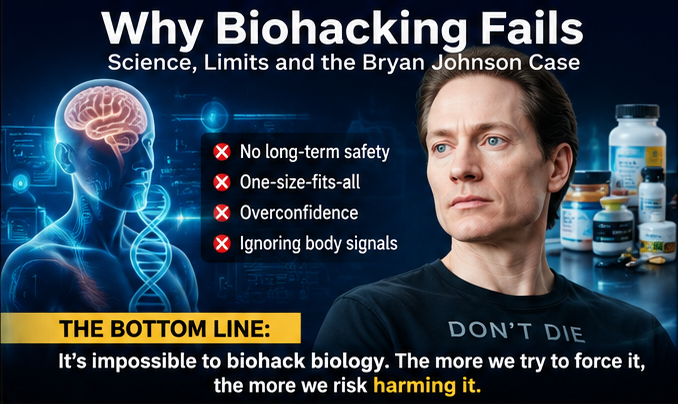
And perhaps one of the most interesting examples of this limitation is Bryan Johnson.
The Biohacking Dream
Bryan Johnson is a wealthy technology entrepreneur who has become one of the world’s most recognizable longevity enthusiasts.
His Project Blueprint has spent millions every year on a team of physicians, hundreds of blood panels, MRIs, extreme caloric control, dozens of daily supplements, and even experimental plasma exchanges with his own teenage son — all in pursuit of a single goal: don’t die. Or, at minimum, reverse the biological clock and prove that aging is an “engineering problem” that can be solved with enough data.
The philosophy is understandable.
If you can measure something, perhaps you can improve it.
If you can improve enough biological markers, perhaps you can slow aging.
And if you can slow enough aspects of aging, perhaps you can live much longer.
But there is a dangerous assumption hidden inside that logic:
That enough measurements and interventions give us control over biology.
They don’t.
The Bryan Johnson Wake-Up Call
In 2026, Johnson announced that he had been diagnosed with autoimmune gastritis, a chronic condition in which the immune system attacks cells in the stomach lining. The disease can interfere with iron and vitamin B12 absorption and can increase the risk of complications, including pernicious anemia and stomach cancer.
What the Bryan Johnson case actually proves
This does not prove that biohacking caused his autoimmune gastritis.
That would be an unjustified conclusion.
But his experience demonstrates something much more important:
Even extreme health optimization cannot give a human being complete control over biology.
What makes Johnson’s story so instructive isn’t that he failed to try hard enough. It’s the opposite. He had virtually unlimited resources, a team of the world’s top physicians, and a level of self-tracking that no ordinary person could replicate. If biohacking worked the way its advocates claim — if health really were an engineering problem you could solve with enough money and enough data — Bryan Johnson should be the healthiest, most protected person on the planet.
Instead, his own immune system developed a condition that attacks the very organ responsible for digesting the food, supplements, and nutrients his entire protocol was built around. There’s a bitter irony in that: the system he trusted to absorb the inputs of his optimization plan is the system that turned against him.
This is the pattern that shows up again and again in extreme self-optimization stories, even when they’re less dramatic than Johnson’s. People chase a metric — a resting heart rate, a glucose curve, a supplement stack borrowed from a podcast — and mistake progress on that metric for actual health. But a body is not the sum of its measurable parts. It’s an interconnected, self-regulating whole, and it has a way of sending a bill for anything it perceives as an imbalance, even when that imbalance was engineered with the best of intentions.
Why this matters beyond one millionaire’s story
You don’t need a $2-million-a-year protocol to fall into the same trap. Every time someone stacks supplements because an influencer swears by them, fasts for days without medical guidance, or ignores fatigue, pain, or cravings because a wearable says their “recovery score” is fine, they’re playing the same game Bryan Johnson played just with fewer resources and less oversight.
The deeper problem with biohacking culture is that it teaches people to trust tests and numbers over their own body’s signals. Real health isn’t found by silencing or overriding those signals with more data and more inputs. It’s found by understanding them — by taking responsibility for the root causes behind fatigue, cravings, inflammation, or imbalance instead of trying to hack around them with a shortcut. That’s a slower, less flashy process than a biohacking headline. It’s also the only one that actually works with the body instead of against it.
The conclusion biohacking culture doesn’t want to hear
You cannot hack a system you are not outside of. Biohacking assumes there’s a “you” standing apart from your biology, poking at levers and reading dashboards, in control of the machine underneath. But there is no machine underneath — there is only you, and your biology is not a separate system to be optimized from the outside. It is self-regulating, adaptive, and, when pushed too far in any one direction, it protects itself in ways no algorithm can fully predict.
That’s why biohacking isn’t just a fad that will quietly fade out of the wellness conversation. It’s a trend built on a false premise, and false premises eventually collect their debt.
Stop Trying to Hack Your Body. Start Supporting It.
Perhaps the future of longevity doesn’t require more extreme interventions.
Perhaps it requires something much less exciting:
Understand the body. Respect its complexity. Give it what it needs. Remove what harms it. And stop assuming that more intervention automatically means more health.
The human body has been adapting, repairing, regulating, and responding to its environment all the time.
Our job isn’t to outsmart biology.
Our job is to work with it.
The longevity industry itself illustrates this problem.
Johnson’s current Blueprint business sells a large range of supplements and products, including nutritional formulas, antioxidants, protein products, creatine, omega-3 products, microbiome products, and other interventions.
There is nothing inherently wrong with selling supplements.
The problem begins when consumers start believing that health requires a complicated stack of products and technologies.
It doesn’t.
What About the Things Biohacking Gets Right?
This is where we need to be fair.
Biohacking isn’t wrong about everything.
Some of its most basic recommendations are remarkably sensible.
Get enough sleep.
Exercise.
Eat nutritious food.
Maintain a healthy weight.
Don’t smoke.
Limit harmful substances.
Manage stress.
Pay attention to your health.
Build meaningful relationships.
These aren’t revolutionary discoveries.
They’re fundamentals.
And interestingly, current longevity guidance continues to emphasize many of these same basic behaviors. Harvard Health recently highlighted movement, nutrition, sleep, stress reduction, and social connection as major pillars of healthy longevity.
The problem is that the simple things aren’t exciting.
You can’t easily sell a revolutionary $500 protocol for getting eight hours of sleep.
You can’t patent a walk.
You can’t turn spending time with people you love into an exotic longevity treatment.
So, the wellness marketplace naturally gravitates toward things that sound more advanced.
That’s where the hype begins.
Longevity Is Not the Same as Health
Perhaps the biggest mistake in the biohacking movement is confusing living longer with living better.
What is the point of adding years to your life if those years are dominated by illness, medications, weakness, isolation, or dependence?
The goal shouldn’t simply be to manipulate biological-age scores.
The goal should be healthy longevity.
That means maintaining physical function, mental clarity, independence, meaningful relationships, and the ability to participate in life.
The best evidence doesn’t point toward one magical intervention.
It points toward a combination of sustainable lifestyle behaviors.
A systematic review of lifestyle interventions found benefits associated with nutrition, physical activity, cognitive engagement, social connection, sleep, and preventive health measures.
That isn’t nearly as glamorous as biohacking.
But it is much more practical.
The Real Lesson From Bryan Johnson
I don’t see Bryan Johnson’s diagnosis as something to celebrate.
Quite the opposite.
Anyone who develops a chronic illness deserves compassion, regardless of their lifestyle.
But his experience gives us an important lesson.
You can have extraordinary resources.
You can measure yourself constantly.
You can hire experts.
You can take supplements.
You can follow an incredibly disciplined routine.
You can spend millions of dollars pursuing longevity.
And you can still become sick.
That’s because biology isn’t a machine waiting to be hacked.
We can influence biology.
We can support it.
We can reduce known risk factors.
We can detect disease earlier.
We can make healthier choices.
And we can improve our odds of living longer and healthier.
But we cannot completely control the biological process.
Stop Trying to Hack Your Body. Start Supporting It.
Perhaps the future of longevity doesn’t require more extreme interventions.
Perhaps it requires something much less exciting:
Understand the body. Respect its complexity. Give it what it needs. Remove what harms it. And stop assuming that more intervention automatically means more health.
Biohacking may offer useful tools, but tools are not the same thing as mastery.
The human body has been adapting, repairing, regulating, and responding to its environment for millions of years.
Our job isn’t to outsmart biology.
Our job is to work with it.
The Bottom Line
The Bryan Johnson case doesn’t prove that biohacking caused his disease.
It proves something more fundamental: even the most sophisticated attempts to optimize the human body cannot eliminate biological uncertainty.
We can influence biology, but we cannot completely control it.
You cannot biohack biology.
And when biohacking turns into an obsession with extreme diets, endless supplements, aggressive interventions, and the illusion of total control, it isn’t simply another health trend.
It can become a source of unnecessary risk.
The path to healthy longevity may be far less complicated than the biohacking industry wants us to believe.