
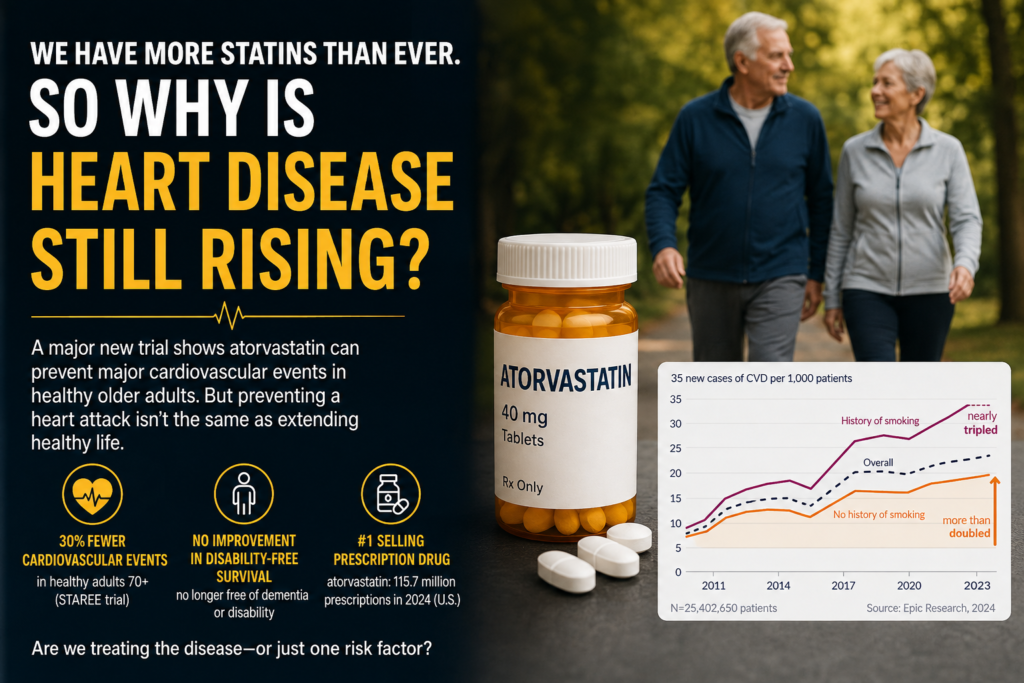



A major new trial shows atorvastatin can prevent cardiovascular events in healthy older adults. But preventing a heart attack is not necessarily the same as extending healthy life.
Atorvastatin is the most prescribed drug in the United States. In 2024 alone, nearly 30 million Americans received approximately 116 million prescriptions for it.
Statins have been prescribed for decades. They lower LDL cholesterol, and evidence shows they can reduce the risk of heart attacks and strokes.
Yet cardiovascular disease has certainly not disappeared.
In fact, an analysis of more than 25 million Americans under 40 found that new cardiovascular disease diagnoses more than doubled, from 9.4 cases per 1,000 patients in 2010 to 22 per 1,000 in 2023. Among people with a history of smoking, the rate nearly tripled.
So we should ask an uncomfortable question:
If we have better drugs, better technology, and more prescriptions than ever, why is cardiovascular disease still such a problem?
The answer is not that statins don’t work.
They do.
But perhaps we have confused reducing one risk with creating health.
A New Reason to Give Statins to Healthy Older Adults
In August 2026, the New England Journal of Medicine published the results of the STAREE trial, one of the largest studies to investigate statin therapy specifically in healthy older adults.
Researchers recruited 9,971 adults aged 70 and older living independently in Australia. Importantly, they had no history of cardiovascular disease, diabetes, or dementia.
Half received 40 mg of atorvastatin daily. The other half received a placebo.
After a median follow-up of 5.9 years, atorvastatin produced an impressive result.
Major cardiovascular events occurred at a rate of 10.9 per 1,000 person-years among people taking atorvastatin, compared with 15.5 among those taking placebo.
That translates into approximately a 30% relative reduction in major cardiovascular events.
That is meaningful.
But it isn’t the whole story.
Fewer Heart Attacks, But Longer Healthy Lives?
The researchers weren’t interested only in heart attacks and strokes.
They also asked a much bigger question:
Would atorvastatin help these older adults remain alive, free of dementia, and free of persistent physical disability for longer?
It did not.
Death from any cause, dementia, or persistent physical disability occurred at a rate of 21.6 per 1,000 person-years in the atorvastatin group and 23.0 in the placebo group.
The difference was not statistically significant.
Read that distinction carefully.
The drug significantly reduced cardiovascular events.
But the study did not demonstrate longer disability-free survival.
That doesn’t mean atorvastatin doesn’t work. And it doesn’t mean preventing a heart attack or stroke isn’t valuable.
It means that preventing cardiovascular events and extending healthy life are not necessarily the same thing.
The 30% Number Isn’t What It Sounds Like
“30% fewer cardiovascular events” makes a spectacular headline.
But it is a relative risk reduction.
Over the trial, a primary cardiovascular event occurred in 297 people assigned atorvastatin and 412 assigned placebo.
So the drug clearly provided cardiovascular protection.
But this is exactly why patients deserve to understand both relative risk and absolute benefit, rather than hearing only the most impressive percentage.
A 30% relative reduction doesn’t mean that 30 out of every 100 people taking atorvastatin were saved from a heart attack.
The distinction matters when asking millions of otherwise healthy people to consider taking medication for years.
But They’re Healthy. Why Give Them a Drug?
This is where STAREE could have enormous implications.
These weren’t patients who already had cardiovascular disease.
The researchers deliberately studied older adults without clinical cardiovascular disease, diabetes, or dementia.
The results may therefore help influence future decisions about primary prevention in older people. The European Society of Cardiology noted that the findings may help inform future treatment guidelines.
And that creates a legitimate question.
How far should preventive medicine go?
If you’re 75, independent, without cardiovascular disease, diabetes, or dementia, should age and cardiovascular risk alone be enough reason to begin taking another medication?
For someone at substantial cardiovascular risk, the answer may well be yes.
For someone at low absolute risk, the calculation may look very different.
That decision shouldn’t be made from a headline.
Older Adults Already Take a Lot of Medication
This becomes even more important when we look at medication use among older adults.
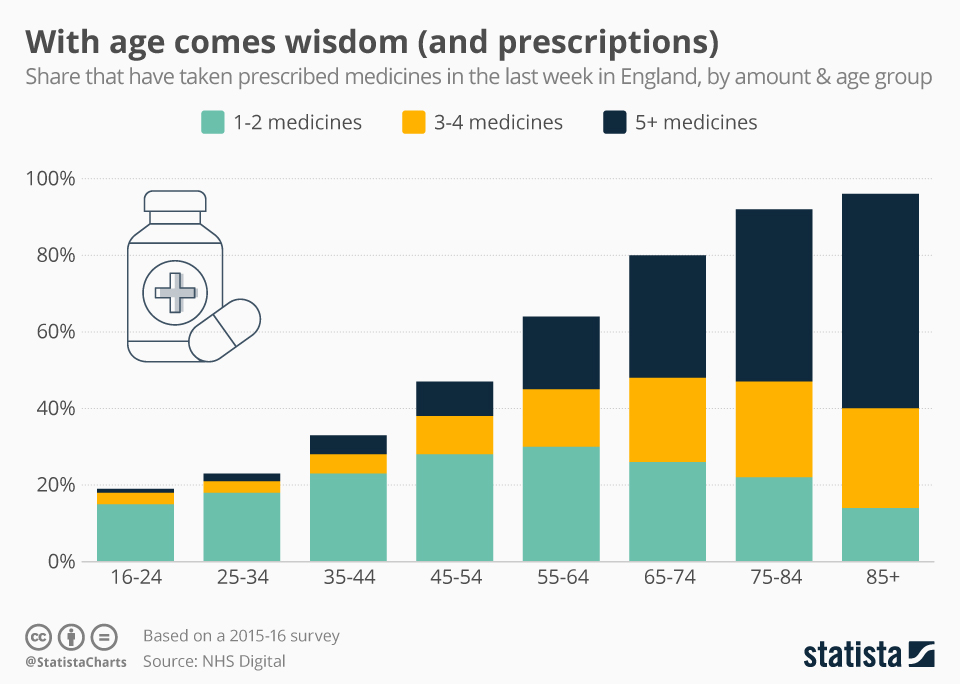
The chart accompanying this article illustrates how prescription-drug use rises dramatically with age.
So STAREE should not be interpreted in isolation. We are discussing adding preventive medication to a population in which taking medications is already normal.
Atorvastatin itself is hardly a niche drug. It ranked #1 by U.S. prescriptions in 2024, with 115.7 million prescriptions for approximately 29.7 million patients.
The question therefore isn’t whether medication is good or bad.
That’s far too simplistic.
The question is whether more medication always means better health.
What About Dementia?
Statins have also generated years of debate about cognition and dementia.
Here we need to be especially careful.
Harvard Health reviewed the evidence and described the research as inconsistent, while noting that a large study of adults 65 and older found no increased incidence of dementia or cognitive decline among statin users. Harvard’s experts concluded that it remained unclear whether statins prevent dementia, have a neutral effect, or increase risk.
More recent Harvard guidance is more reassuring, stating that large trials have not demonstrated an increase or decrease in cognitive function over time.
And importantly, STAREE itself did not establish that atorvastatin increases dementia.
So claiming that atorvastatin causes Alzheimer’s would go beyond the evidence.
The more relevant point for this discussion is simpler:
STAREE did not demonstrate that atorvastatin extended survival free of dementia and disability.
That’s what the trial actually found.
If Statins Work, Why Is Cardiovascular Disease Still Rising?
This may be the most important question of all.
The rise in cardiovascular disease among young adults does not prove statins have failed. Most young adults aren’t the population for whom statins are routinely prescribed.
But the trend exposes a larger problem.
Epic Research found that CVD diagnoses among adults under 40 more than doubled between 2010 and 2023, including among nonsmokers. The researchers concluded that factors beyond smoking and BMI appeared to be contributing to the increase.
We have become extraordinarily sophisticated at treating risk factors.
We lower cholesterol.
We lower blood pressure.
We control blood glucose.
And when one number rises, increasingly we have a medication capable of lowering it.
Yet medications cannot substitute for creating a healthier population.
A statin cannot undo smoking.
It cannot replace physical activity.
It cannot transform an unhealthy diet.
It cannot reverse every consequence of obesity, chronic stress, poor sleep, or metabolic dysfunction.
And it certainly cannot stop aging.
The lesson from STAREE should not be:
Statins don’t work.
They clearly reduce cardiovascular events.
Nor should it be:
Everyone over 70 should take atorvastatin.
The trial doesn’t establish that either.
Instead, perhaps we should ask:
What outcome are we actually trying to achieve?
If the objective is reducing the probability of a major cardiovascular event, STAREE provides compelling evidence that atorvastatin can help.
But if the objective is living longer while remaining physically independent and cognitively healthy, the same trial did not demonstrate a significant benefit.
Those are fundamentally different promises.
We are all eventually going to die from something. That doesn’t make prevention meaningless. Preventing a devastating stroke or heart attack can be enormously valuable.
But medicine should also recognize the difference between preventing a disease and extending healthy life.
Perhaps the future of healthy aging shouldn’t simply be about finding another drug to reduce another risk factor.
It should be about asking a much bigger question:
Are we adding years to healthy life, or simply adding more treatment to the years we already have?
So STAREE should not be interpreted in isolation. We are discussing adding preventive medication to a population in which taking medications is already normal.
Atorvastatin itself is hardly a niche drug. It ranked #1 by U.S. prescriptions in 2024, with 115.7 million prescriptions for approximately 29.7 million patients.
The question therefore isn’t whether medication is good or bad.
That’s far too simplistic.
The question is whether more medication always means better health.
What About Dementia?
Statins have also generated years of debate about cognition and dementia.
Here we need to be especially careful.
Harvard Health reviewed the evidence and described the research as inconsistent, while noting that a large study of adults 65 and older found no increased incidence of dementia or cognitive decline among statin users. Harvard’s experts concluded that it remained unclear whether statins prevent dementia, have a neutral effect, or increase risk.
More recent Harvard guidance is more reassuring, stating that large trials have not demonstrated an increase or decrease in cognitive function over time.
And importantly, STAREE itself did not establish that atorvastatin increases dementia.
So claiming that atorvastatin causes Alzheimer’s would go beyond the evidence.
The more relevant point for this discussion is simpler:
STAREE did not demonstrate that atorvastatin extended survival free of dementia and disability.
That’s what the trial actually found.
If Statins Work, Why Is Cardiovascular Disease Still Rising?
This may be the most important question of all.
The rise in cardiovascular disease among young adults does not prove statins have failed. Most young adults aren’t the population for whom statins are routinely prescribed.
But the trend exposes a larger problem.
Epic Research found that CVD diagnoses among adults under 40 more than doubled between 2010 and 2023, including among nonsmokers. The researchers concluded that factors beyond smoking and BMI appeared to be contributing to the increase.
We have become extraordinarily sophisticated at treating risk factors.
We lower cholesterol.
We lower blood pressure.
We control blood glucose.
And when one number rises, increasingly we have a medication capable of lowering it.
Yet medications cannot substitute for creating a healthier population.
A statin cannot undo smoking.
It cannot replace physical activity.
It cannot transform an unhealthy diet.
It cannot reverse every consequence of obesity, chronic stress, poor sleep, or metabolic dysfunction.
And it certainly cannot stop aging.
Maybe We’re Asking the Wrong Question
The lesson from STAREE should not be:
Statins don’t work.
They reduce cardiovascular events.
Nor should it be:
Everyone over 70 should take atorvastatin.
The trial doesn’t establish that either.
Instead, perhaps we should ask:
What outcome are we actually trying to achieve?
If the objective is reducing the probability of a major cardiovascular event, STAREE provides compelling evidence that atorvastatin can help.
But if the objective is living longer while remaining physically independent and cognitively healthy, the same trial did not demonstrate a significant benefit.
Those are fundamentally different promises.
We are all eventually going to die from something. That doesn’t make prevention meaningless. Preventing a devastating stroke or heart attack can be enormously valuable.
But medicine should also recognize the difference between preventing a disease and extending healthy life.
Perhaps the future of healthy aging shouldn’t simply be about finding another drug to reduce another risk factor.
It should be about asking a much bigger question: