
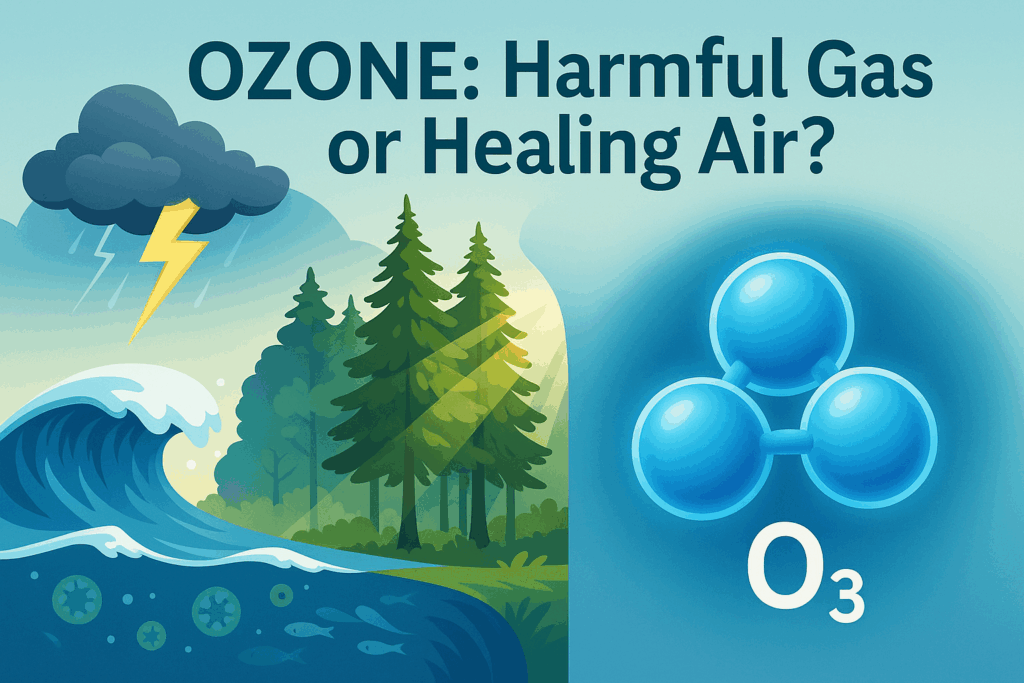




When most people hear the word ozone, they think of it as a harmful pollutant, something that damages our lungs and fills our cities with smog. Yet ozone is also known as the “breath of God,” a natural purifier that gives mountain air its freshness and creates that clean, sharp scent after a thunderstorm.
So which is it, dangerous or life-giving? The truth is that ozone is one of the most misunderstood elements in the air we breathe. In balanced, natural amounts, it’s essential for our health. In excessive, artificial concentrations, it can be irritating. The key is context.
In this post, we’ll explore:
- What ozone is and how it works
- How nature produces ozone in forests, oceans, and storms
- Why urban ozone is different
- The hidden dangers of indoor air without ozone
- How ozone is being used in medicine and therapy
What Exactly Is Ozone?
Ozone is simply oxygen in an enriched form. While ordinary oxygen (O₂) is made of two atoms, ozone (O₃) has three. That extra oxygen atom makes ozone highly reactive, giving it powerful cleansing properties.
- Lifespan: Ozone only lasts about 20–30 minutes before breaking down into regular oxygen.
- Function: During that short time, it acts as one of Earth’s most effective oxidizers, neutralizing pollutants, inactivating bacteria and viruses, and restoring freshness to the air.
- Natural role: After doing its job, ozone reverts to stable O₂, leaving the air cleaner than before.
This explains why ozone can seem like a contradiction. In the right amounts, it serves as a natural purifier. In excess, especially indoors or in cities with high chemical pollution, it can become irritating.
How Nature Produces Ozone
For millions of years, ozone has been quietly sustaining life. It forms whenever oxygen interacts with sunlight, plant compounds, or electrical energy. Let’s look at the main ways nature makes ozone.
1. Forests and Vegetation: The Green Lungs of the Earth
Forests don’t just produce oxygen through photosynthesis – they also create natural ozone. Trees and plants release hydrocarbons (like terpenes), which react with sunlight and oxygen to generate ozone in the surrounding air.
This is why forest air feels different:
- Fresher and lighter to breathe
- Energizing and mood-lifting
- Rich in oxygen, ozone, and negative ions
Science confirms what humans have felt for centuries. Time in forests reduces stress, strengthens immunity, and improves lung function. The Japanese practice of “forest bathing” (Shinrin-yoku) is based on this principle.
Unfortunately, deforestation threatens this natural ozone source. Every acre of forest lost reduces the Earth’s ability to generate clean air.
2. Oceans and Plankton: The Planet’s Blue Lungs
While rainforests are often called the “lungs of the Earth,” it’s actually the oceans that produce most of our oxygen. Phytoplankton, microscopic plants floating near the surface, generate more than half of the oxygen in our atmosphere.
When this oxygen rises and interacts with UV rays, ozone is formed. This explains why coastal air feels so invigorating – it’s naturally enriched with oxygen, ozone, and negative ions.
For centuries, doctors prescribed “sea air” to patients with respiratory or chronic illnesses. Modern science now shows why: seaside environments contain higher natural ozone levels, which refresh the lungs and improve circulation.
But plankton are under threat from pollution, overfishing, and climate change. A decline in plankton means a decline in oxygen and natural ozone, an issue with direct consequences for human health.
3. Thunderstorms: Nature’s Air Reset
One of the most dramatic ways ozone is formed is during a thunderstorm. Lightning’s electrical discharge splits oxygen molecules (O₂) into single atoms, which quickly recombine into ozone (O₃).
The result is the unmistakable fresh, sweet smell after a storm, air that has literally been purified and recharged with ozone.
Thunderstorms don’t just bring rain; they act as massive air purifiers, killing airborne bacteria, neutralizing pollutants, and refreshing the environment.
Ozone in Cities: Cleaner or Dirtier?
In urban areas, ozone behaves differently. When car exhaust, factory emissions, and hydrocarbons react with UV rays, ozone is created as part of smog. Because it appears alongside other toxins, ozone is often blamed for the problem.
In reality, ozone is nature’s emergency response, trying to neutralize pollution. The real culprits are nitrogen oxides, sulfuric compounds, and industrial chemicals. Ozone itself is not the danger; the toxic cocktail of smog is.
This is where dosage matters. Natural ozone in forests or mountains is beneficial. Excessive ozone trapped in urban smog can irritate the lungs.
Indoor Air: The Hidden Danger
Most people assume outdoor air pollution is their biggest threat. In reality, indoor air is often far worse.
Modern airtight buildings trap pollutants and block natural ozone from entering. Without sunlight, fresh air, or nature’s cleansing forces, toxins accumulate.
Common Indoor Pollutants:
- Building materials & furniture: VOCs like formaldehyde and styrene off-gas for months.
- Cleaning products: Many sprays and fragrances release harmful chemicals.
- Cigarette smoke: Contains over 3,600 toxins.
- Pets & pests: Dander, fur, droppings, and allergens.
- Mold & mildew: Thrive in damp, poorly ventilated spaces without sunlight or ozone.
Indoors, these pollutants are not balanced by wind, UV rays, or natural ozone. The result? Chronic headaches, fatigue, allergies, respiratory irritation, and even long-term illness.
This is why improving indoor air quality is not optional – it’s essential for health.
Ozone in Medicine and Therapy
Beyond its role in the environment, ozone has been studied and used in medicine for over a century.
A Brief History
- 1840: German scientist Christian Schönbein discovered ozone.
- 1857: Werner von Siemens built the first ozone generator.
- 1870s onward: Doctors in Europe used ozone for disinfection and wound healing.
- Today: Ozone is used in water purification, food preservation, and medical therapies.
Ozone Therapy in Health
In Europe, South America, and parts of Asia, ozone therapy is used to:
- Improve oxygen delivery to tissues
- Support circulation and immunity
- Reduce inflammation in joints and chronic conditions
- Complement cancer therapies
- Aid in detoxification
Methods of Therapy
- Injection/Autohemotherapy: Blood is briefly mixed with ozone before reinfusion.
- Ozone tent therapy: The body absorbs ozone through the skin in a sealed chamber.
- Ozone sauna: Steam and heat open pores, enhancing absorption and detoxification.
Patients often report improved energy, better circulation, and reduced chronic symptoms. While not widely recognized in the U.S., thousands of studies support its benefits.
Conclusion
Ozone is not our enemy. It is a natural purifier, created by sunlight, storms, forests, and oceans to keep the Earth’s air clean. In cities, it shows up as part of nature’s attempt to neutralize man-made pollution. Indoors, its absence allows toxins to accumulate.
For health and longevity, we need to:
- Spend more time outdoors in natural environments
- Improve ventilation and reduce chemical use indoors
- Protect forests and oceans the Earth’s true air purifiers
- Stay open to safe, research-backed uses of ozone in medicine
The more we understand ozone, the more we see it for what it is: a gift of nature, designed to cleanse, refresh, and sustain life.