
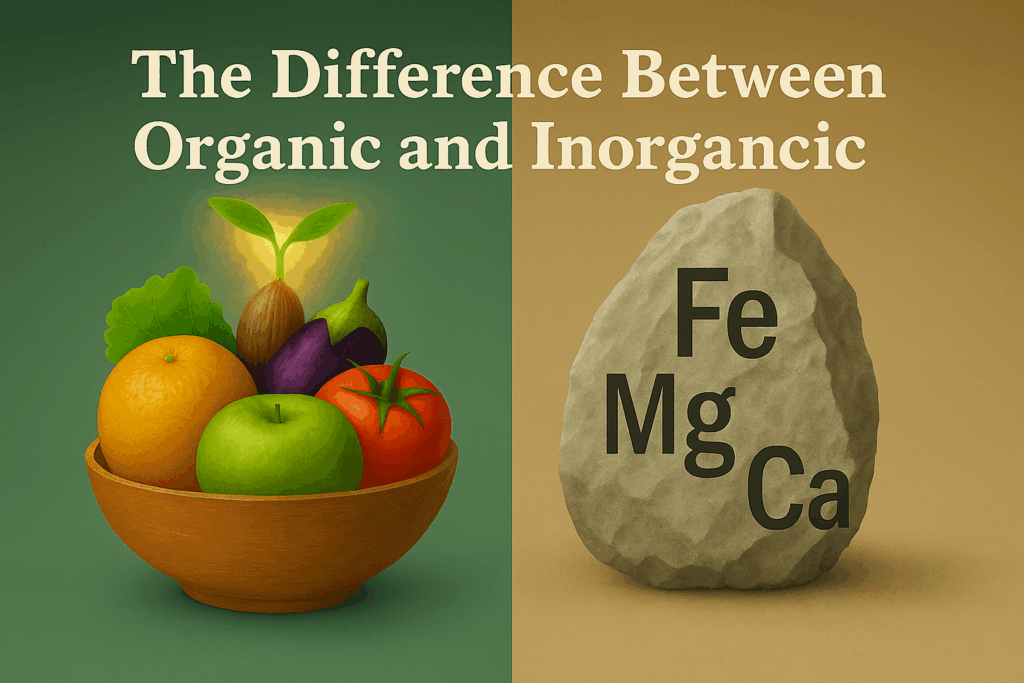


It is very important to understand one of the basic errors often made in nutrition and health. The error lies in the misunderstanding of the difference between organic and inorganic elements. And to be clear, this has nothing to do with “organic food” as sold in health food stores compared to conventionally grown food. Instead, it refers to whether elements come from living sources or lifeless matter.
Organic elements are found in all living things, in plants, and in animals. Inorganic elements are found in rocks, metals, and the soil of the earth. The United States Pharmacopoeia has stated that if an element looks the same under a microscope, it is considered the same element, whether it is lifeless or filled with the energy of life. For example, vitamin C can be produced in a laboratory as ascorbic acid, or it can come from a freshly squeezed orange. On paper, they may look the same, but they are not.
Life energy is what makes the difference. It is the unseen vitality in a sunflower seed that allows it to grow into a tall plant producing hundreds of new seeds. It is in the seed of a tree that becomes a strong, mature tree. It is in the reproductive systems of animals that bring forth new life. Life gives life. In nature, every animal is nourished by organic elements. Carnivores eat fresh meat from living prey, herbivores eat fresh plants, and omnivores eat a mix of both.
Plants play a unique and irreplaceable role in the cycle of life. They act as nature’s great alchemists, transforming lifeless matter into living nourishment. Through their root systems, plants draw in inorganic minerals from the soil, calcium, magnesium, potassium, iron, and countless trace elements. On their own, these raw minerals from the earth are not in a form that humans or animals can fully utilize. A rock may contain calcium, but our bodies cannot digest or absorb it directly.
This is where photosynthesis, one of the most extraordinary processes in nature, comes into play. Using sunlight as energy, plants take in carbon dioxide from the air, water from the ground, and minerals from the soil, then transform them into organic compounds. The result is living tissue – leaves, fruits, seeds, grains, and vegetables rich with vitamins, enzymes, and biologically available minerals. These compounds now carry the “life spark” that can sustain animals and humans.
Even carnivores ultimately depend on this transformation. A lion may never touch a leaf, but the zebra it eats has already grazed on grass. The flesh of the zebra is simply planting nutrients that have been converted into animal tissue. In this way, all animals, including humans, rely on plants either directly or indirectly for their survival. Plants stand at the foundation of the food chain, turning inorganic matter into life-giving nourishment.
For humans, this connection is even more essential. Our digestive systems are best equipped to thrive on the organic nutrients created by plants. Fresh fruits, vegetables, nuts, seeds, and grains provide us with the enzymes and minerals our bodies require in a form we can absorb and use. When we consume plant foods, we are not just feeding ourselves; we are partaking in the very miracle of life that begins in the soil, passes through the plant, and becomes the fuel for every living creature on Earth.
The Law of Nutrition
Our bodies are composed of roughly seventy percent water and thirty percent organic elements such as proteins, fats, carbohydrates, and minerals. These proportions highlight how deeply dependent we are on balance: water as the medium of life, and organic compounds as the building blocks of cells and tissues. To keep this balance, nature follows an unbreakable principle that can be called the Law of Nutrition.
This law governs every living cell, from the simplest bacterium to the most complex human being. The rule is universal: if it is alive, it must be nourished with something that carries life. In other words, living systems depend on fresh, biologically active food. Once nourished, every living cell must also expel waste. Every act of metabolism, from breaking down sugar for energy to repairing DNA, produces byproducts that must be eliminated to maintain health.
The Law of Nutrition is not a theory; it is a reality that nature enforces on all living creatures. By respecting this law and choosing living, fresh foods, we align ourselves with the same rhythm that sustains every organism on Earth.
In nature, no animal survives on food that has been stripped of its enzymes and vitality by cooking, baking, or frying. Every species, whether it is a lion in the savanna, a deer in the forest, or a bird in the sky, depends on fresh, enzyme-rich food straight from nature. Carnivores eat freshly killed prey, herbivores graze on living grasses and plants, and even omnivores in the wild consume their food in its raw and natural form. None of them relies on processed or artificially altered food for survival.
Yet humans, sitting at the top of the food chain, often convince themselves that this law of life does not apply to us. We take what was once living and vibrant and transform it with heat, chemicals, and additives until little remains of its original vitality. Our supermarkets are filled with foods that look appealing, smell enticing, and may even taste be satisfying, but are stripped of the enzymes and life force that the body depends on.
Life Comes From Life
Consider the difference between eating a fresh apple picked from a tree and a packaged apple pie from the store. The apple comes with fiber, vitamins, minerals, and enzymes that help your body digest and absorb its nutrients. The apple pie, while flavorful, has been baked at high temperatures, destroying enzymes and altering the very structure of its nutrients. What remains is a lifeless mixture of refined sugar, processed flour, and unhealthy fats that the body must struggle to process. The outward appearance is still “food,” but the living energy that once nourished the body is gone.
When we fill our bodies with this lifeless food day after day, the consequences slowly show up in our health. Fatigue, digestive problems, weakened immunity, premature aging, and chronic disease often follow. The body cannot thrive on food that only imitates nourishment. It needs the vitality, enzymes, and living energy found in fresh fruits, vegetables, nuts, seeds, and whole grains.
The truth is simple. Life comes from life. Just as no animal in the wild can survive on cooked or processed food, neither can we maintain long-term health and vitality if most of our diet is made up of enzyme-dead, highly processed meals. Our modern lifestyle may try to bend this natural law, but nature always has the final say.