
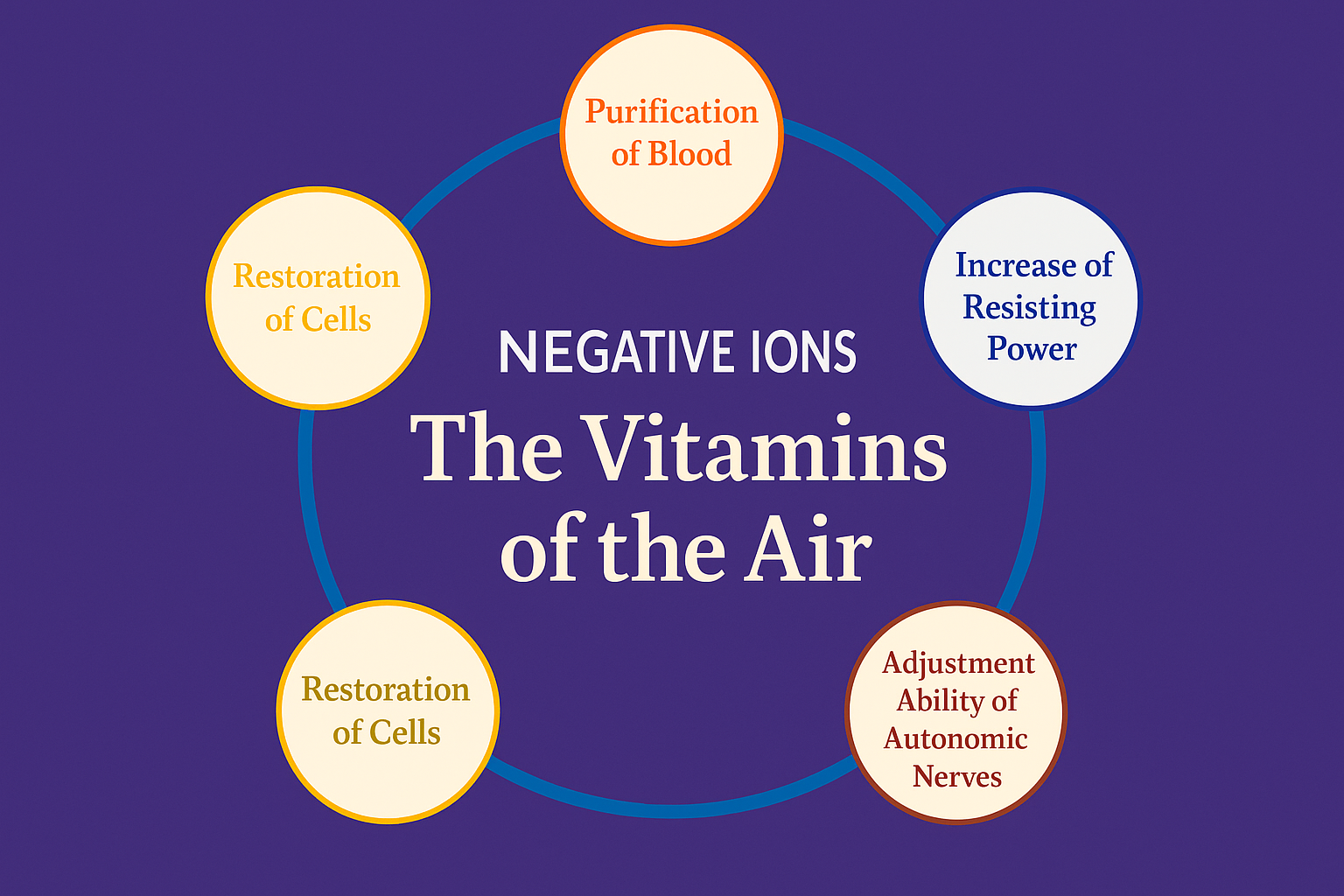


Have you ever noticed how refreshed you feel after a walk in the woods, standing by the ocean, or breathing in the air after a thunderstorm? That lightness, clarity, and boost in energy are not just in your imagination – it’s the power of negative ions, sometimes called the vitamins of the air.
Negative ions are tiny charged particles in the atmosphere that have profound effects on both physical and mental health. Modern science has shown that these invisible molecules influence mood, vitality, and even disease resistance. Yet most of us spend our days indoors, surrounded by stale, negative ion-depleted air, without realizing the toll it takes on our well-being.
In this article, we’ll explore:
- What ions are and how they work
- The history of ion research
- The health effects of positive vs. negative ions
- Scientific studies connecting negative ions with mood and immunity
- Practical ways to restore ion balance indoors
What Are Ions and Why Do They Matter?
Air, like all matter, is made of molecules with positive and negative charges. Normally, these charges balance each other out. When molecules lose or gain electrons, they become ions.
- Positive ions form when a molecule loses an electron.
- Negative ions form when a molecule gains an electron.
Fresh outdoor air usually contains a balance of about five positive ions for every four negative ions. This ratio is essential to life. When the balance tips too far, especially toward positive ions, health problems begin.
Negative ions are created by natural forces:
- Sunlight and ultraviolet rays
- Lightning during thunderstorms
- Waterfalls and ocean waves
- Forests and vegetation
This explains why people feel energized and uplifted in nature-rich environments and why sealed indoor spaces often feel draining.
Early Studies on Atmospheric Electricity
The study of electricity in the air goes back centuries. In 1752, Benjamin Franklin’s kite experiment proved that lightning is a form of electricity. Franklin suspected that this atmospheric energy influenced weather, plant growth, and human health.
Other pioneers followed:
- In 1748, French scientist L’Abbé Nollet showed that plants under electric fields grew faster.
- In 1775, Italian researcher Gian Battista Baccaria suggested that electricity in the atmosphere stimulated vegetation.
By the late 19th century, scientists identified that the real agents were charged gas molecules – ions. It took until the 1970s for modern science to confirm that ion balance is essential to life, with imbalances linked to illness, fatigue, and mental health problems.
Experiments with Plants, Animals, and Humans
University of California scientists tested plants in ion-depleted air. Crops like peas and lettuce stopped growing and became diseased. Similarly, lab animals raised in ion-free environments grew weak and sickly.
Humans evolved in ion-rich air, and when deprived of it, we too suffer. Studies across Japan, Russia, Israel, Brazil, and Europe found that ion-depleted environments increased fatigue, depression, and illness. Meanwhile, negative ions consistently improved vitality.
Over 5,000 scientific papers now confirm:
- Excess positive ions are harmful.
- High concentrations of negative ions have a healing effect.
How the Balance of Ions Gets Disturbed
Several factors can disrupt the natural ion balance:
- Dust and pollution: Particles bind to negative ions, leaving excess positive ions.
- Hot, humid days: Heavy air depletes negative ions, which is why such weather feels oppressive.
- Strong winds: Certain winds, such as the Santa Ana in California or the Foehn in Europe, carry excessive positive ions and are linked to spikes in depression, irritability, asthma, and even crime.
- Indoor living: Modern airtight buildings prevent fresh ionized air from entering, trapping us in positive-ion environments.
By contrast, thunderstorms recharge the air with negative ions, which is why the atmosphere feels so clean afterward.
The Science of Serotonin and Ions
In the 1950s, researchers at the Hebrew University of Jerusalem discovered that ion balance directly affects serotonin, a neurotransmitter linked to mood, energy, and stress.
- Positive ions overstimulate serotonin, leading to anxiety, migraines, restlessness, and even heart strain.
- Negative ions restore serotonin balance, calming the nervous system and lifting mood.
At the same time, Dr. Albert Krueger at UC Berkeley found that negative ions destroy airborne bacteria, explaining why illnesses like influenza spread more easily indoors, where ions are absent.
Indoor Air: The Hidden Danger
The 1970s energy crisis led architects to design airtight homes and offices to save heating and cooling costs. Unfortunately, this traps pollutants indoors while cutting off natural sources of ozone and negative ions.
Common sources of indoor ion imbalance include:
- VOCs from building materials, carpets, and furniture
- Cleaning supplies and artificial fragrances
- Cigarette smoke
- Mold, mildew, and damp environments
- Electronics and synthetic fabrics, which generate positive charges
The result? Sick Building Syndrome (SBS) and Building-Related Illness (BRI) clusters of fatigue, headaches, allergies, respiratory problems, and depression linked to poor indoor air quality.
Health Effects of Ion Imbalance
Physical Symptoms
- Headaches, dizziness, and nausea
- Shortness of breath, asthma, and allergies
- Fatigue and reduced stamina
- Circulatory strain, blood clotting issues
- Chronic inflammation and pain sensitivity
Psychological Symptoms
- Irritability and nervousness
- Anxiety and depression
- Brain fog and slower reaction times
- Loss of motivation and emotional imbalance
Some people are especially sensitive, experiencing severe serotonin overstimulation in positive-ion environments.
Negative Ions as Natural Medicine
Professor Krueger concluded in the 1960s:
“It is not natural to live in an ion-free environment. Therefore, such a life probably does not contribute to the health of the body.”
Negative ions play two major roles:
- Oxygen carriers – They help deliver oxygen more efficiently into cells, increasing energy and supporting metabolism.
- Air purifiers – They attach to dust, smoke, and pollen, causing them to fall out of the air.
This is why air feels so fresh in forests, near waterfalls, or after a thunderstorm.
Negative Ions vs. Antidepressants
In the 1990s, media reports highlighted how negative ion generators helped patients with depression sometimes more effectively than Prozac. Patients reported relief within 30 minutes, without the side effects of drugs.
Controlled trials later confirmed:
- High-density negative ions improved depression by 50%, comparable to bright light therapy.
- Seasonal Affective Disorder patients improved significantly with daily ion exposure.
- Negative ions improved mental clarity, alertness, and sleep.
Unlike pharmaceuticals, ions restore natural balance instead of chemically altering brain chemistry.
Practical Advice for Modern Living
Because we spend most of our lives indoors, restoring ion balance is crucial. Here’s how:
- Get outdoors daily: Forests, mountains, and coastlines are natural ion generators.
- Breathe morning air: It’s cleaner and richer in oxygen.
- Open windows when possible: Even limited ventilation helps.
- Use ionizers: Modern appliances can recreate nature’s cleansing process indoors.
- Reduce chemical inputs: Limit synthetic fragrances, harsh cleaners, and VOC-heavy furnishings.
These steps not only improve indoor air but also support mental clarity, energy, and long-term vitality.
Conclusion: The Forgotten Nutrient of the Air
Negative ions are the vitamins of the air. They energize, purify, and restore balance to our bodies and minds. For centuries, humans have sought the ocean, forests, and mountains for healing long before science explained why. Today, research confirms that ion-rich environments support better mood, stronger immunity, and overall well-being.
In a world where we spend most of our lives indoors, finding ways to restore ion balance is not a luxury – it is a necessity for health, happiness, and longevity.