


If you’re struggling with excess weight, hear this: it’s not your fault.
The foods you crave weren’t just made to taste good – they were scientifically engineered to make you crave more, over and over, until you lose control and get addicted to them. That loss of control wasn’t weakness. It was a result of intentional design.
The companies behind these foods didn’t create them to nourish you. They created them to hook you. To make you dependent. And the more you eat, the more they profit, no matter the toll it takes on your health.
Your well‑being was never their priority. Your addiction was their business model.
It’s time to uncover the true culprit, the one that’s been right in front of us all along.
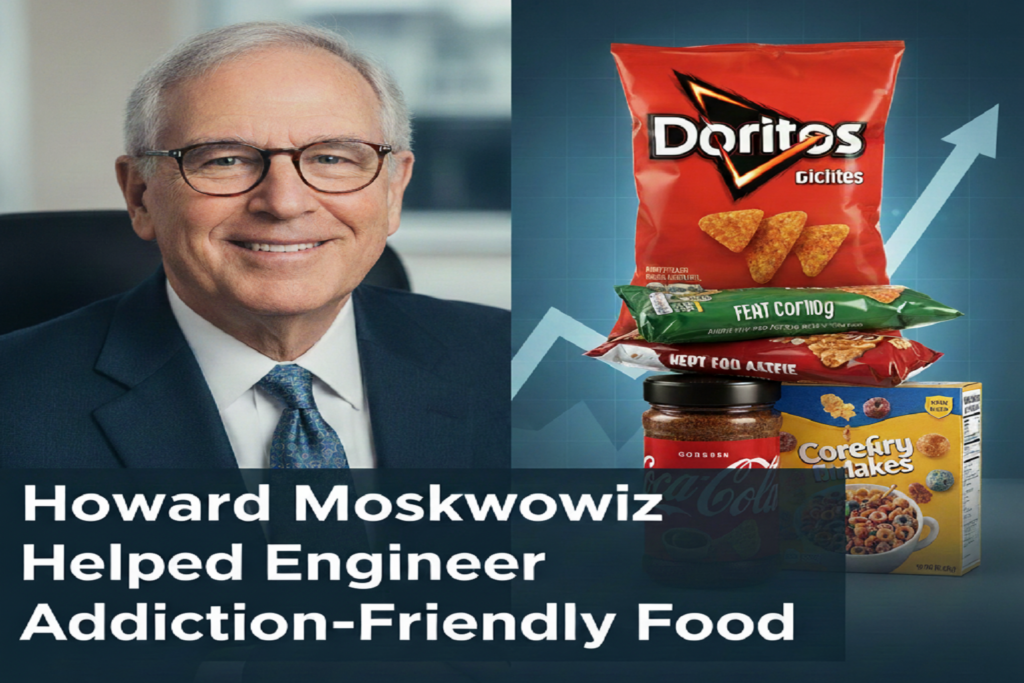
Who is Howard Moskowitz, and why does it matter?
Howard Moskowitz is an American market researcher, psychophysicist, and consumer‑preference specialist. He holds undergraduate degrees in mathematics and psychology from Queens College (City University of New York) and earned his Ph.D. in Experimental Psychology from Harvard in 1969.
Over decades, Moskowitz worked with major food companies Campbell’s Soup, Kraft, PepsiCo, and others, helping them design, test, and optimize food products so that they hit precisely the sensory “sweet spot” consumers prefer.
A key outcome of his work: conceptualizing and deploying what is now widely known as the “bliss point” in food, the exact combination of sugar, fat, salt (and sometimes texture) that maximizes pleasure and makes a food highly rewarding and repeat‑worthy.
The Food Industry and the Built‑in Pleasure Mechanism
When we talk about addiction to sugar‑rich, fat‑rich, or heavily salted processed foods, what we are really seeing is a biological and psychological reaction to powerful sensory stimuli.
Research on the bliss point suggests that when foods hit just the “right” level of sweetness, fat content, saltiness (and even texture), they yield maximal pleasure. The human brain responds with a flood of dopamine and other neurotransmitters. That creates a memory: “This felt good.” That memory motivates repeat behavior, cravings, and eventually dependence.
Because of Moskowitz’s optimization work, the foods that followed didn’t just taste good. They became deeply satisfying. They triggered a reward in the brain stronger than everyday, natural foods, so the brain “wanted” more.
Take it simple: when companies craft a sauce, a snack, or a soda, they tweak sugar, fat, salt, crunch, and texture until they hit that bliss point. At that point, eating becomes less about nourishment, more about reward. The result: repeat consumption, cravings, and eventually addictive‑like eating habits.
Moskowitz’s Optimization Techniques: Precision in Pleasure
Moskowitz didn’t guess at what people liked. He used rigorous methodology.
-
- Consumer preference segmentation. He realized there isn’t one “perfect” recipe that works for everyone. Instead, different groups have different sensory preferences.
-
- Psychophysics: This is the science of how physical stimuli translate into perception. He and his team tested different variations of recipes (salt levels, fat levels, texture, chunkiness, viscosity), then measured how strongly each was preferred.
-
- Experimental testing: For example, multiple versions of the same spaghetti sauce were tested by consumers. The “extra‑chunky,” sugar‑salt‑fat balanced version performed best. That became the recipe.
Once food manufacturers discovered these formulas, they were rolled out across many products: soups, sauces, chips, cookies, sodas, fast food items, and snacks everywhere.
The result: a food environment engineered not for nourishment or health, but for maximal appeal, repeat consumption, and profit.
From Pleasure to Dependence: Food Optimization and Addiction‑like Behavior
What separates occasional indulgence from addiction‑like behavior is repeat consumption, loss of control, strong cravings, and a brain reward system trained for repeated engagement.
When food is engineered to hit the bliss point, the brain’s reward pathways are primed not just for taste, but for compulsion. Over time, these foods become a “go‑to” for comfort, reward, and emotional regulation, often in moments of stress, sadness, loneliness, or boredom.
Because these foods are cheap, widely available, heavily marketed, and often tastier than anything naturally occurring, almost everybody is exposed. That increases the opportunity for habitual consumption.
Importantly, the fact that a food triggers craving doesn’t make it “evil” in a moral sense. From a business perspective, Moskowitz was simply giving people what they wanted. But the outcome is that our environment became saturated with products purposefully designed for repeat use and increased consumption, even when that consumption produces negative health consequences.
In effect, what these companies did with flavor is analogous to what the tobacco industry did with nicotine: optimize for uptake, retention, repeat use, and brand loyalty. Only here, the loyalty is at the level of unconscious sensory satisfaction.
To understand the broader impact, consider the full ecosystem that empowers this design:
-
- Recipe optimization: Food companies adopt bliss‑point‑based formulas to craft foods people psychologically love.
-
- Mass production & scale: These recipes are manufactured cheaply, in large volume, and are shelf‑stable.
-
- Marketing & packaging: Appealing visuals, branding, promotions, and flavor innovation keep these products top-of-mind and desirable.
-
- Habit formation: Repeated exposure + powerful reward = craving and habitual consumption.
-
- Health & behavioral consequences: Over time, elevated consumption leads to obesity, metabolic disorders, compulsive eating, and emotional dependency, often with the same hallmarks of addiction.
Ethical Concerns & Public Health Consequences
This manipulation raises serious ethical and public-health concerns.
-
- Manipulation of natural appetites. Human taste preferences for sugar, salt, and fat evolved when these nutrients were scarce and valuable. In our modern environment of unlimited supply, optimizing them to the “bliss point” exploits biological systems meant for scarcity.
-
- Illusion of free choice: People believe they’re making conscious decisions when they buy food. But when the product is engineered to hit brain reward triggers, the choice becomes less free than it appears.
-
- Public health ramifications. Widespread availability of ultra‑palatable, high‑calorie, low‑nutrient foods has contributed to obesity, diabetes, metabolic syndrome, and increased rates of compulsive‑eating disorders.
-
- Addiction parallel: While food doesn’t always produce the same kind of clinical dependence as drugs or nicotine, the behavioral patterns it can produce, such as cravings, overconsumption, and loss of control, often mirror addiction.
What This Means for You: Taking Back Control
Here are actionable ways to apply this insight to your life:
-
- Recognize engineered foods. Be aware that many processed foods you reach for are designed to trigger dopamine/reward, not to nourish. Awareness is your first step.
-
- Ask yourself before you eat. When you feel the urge, question it: am I hungry? Or am I responding to a hyper‑engineered product pulling me in?
-
- Choose whole foods. Foods whose flavor naturally comes from wholesome ingredients, not from blitzed sugar, fat, salt, and chemistry. Cooking whole foods at home gives you control.
-
- Practice mindful eating. Focus on nourishment, texture, satisfaction, not just the dopamine hit. Listen to your body’s signals.
-
- Rewire habits consciously. Understand that your brain can be trained. If the environment is designed to exploit cravings, you can intentionally retrain your mind to value clarity, health, and self‑control over short-term reward.
Why This Story Matters in the Addiction Conversation
When food addiction is discussed, the spotlight tends to land on the individual: willpower, discipline, genetics, and environment. That’s only part of the story.
The other, less discussed part is the product environment itself, the fact that most people’s food options are no longer simple, home‑cooked meals but highly engineered products designed for maximal sensory reward and repeated consumption.
This shift in food architecture has serious implications for personal health. It makes overeating, bingeing, and addiction‑like behaviour easier and more automatic.
Understanding this doesn’t relieve personal responsibility, but it reframes the conversation. It moves it away from shame and moral failure, and toward insight and empowerment.
Once you see how the system works, you regain power: you can choose what you eat, how you eat it, and whether it controls you.
How Howard Moskowitz’s Work Changed the Food Landscape and Raised a Warning
Moskowitz’s methods were far from villainous; he was a scientist optimizing for consumer preference. But the consequences of that optimization weren’t purely benign.
By measuring perception, testing variations, optimizing reward, and then launching the most compelling versions, the food industry unleashed processed foods engineered for maximum sensory reward and repeat engagement.
Over time, those foods saturated global markets. They influenced taste, altered eating habits, rewired reward circuits, and contributed to a food culture where overeating and addiction‑like behavior became normalized.
When you understand this, it changes everything.
If you’re struggling with food addiction, help is just around the corner. Click here to watch the presentation.