


Bryan Johnson, Kate Tolo, Chronic Disease, and the Question Nobody in the Longevity Industry Wants to Ask
Biohacking has become one of the hottest trends in the longevity world.
Measure your biological age. Track your glucose. Analyze your sleep. Optimize your VO2 max. Test your hormones. Measure your body fat. Take supplements. Use wearables. Monitor hundreds, or even thousands, of biomarkers.
And if you have enough money, you can take it much further.
But I have a question that I believe deserves to be asked:
What if you optimize all those numbers and still have chronic disease?
That question became much more interesting to me after learning about the health problems of Bryan Johnson and his partner, Kate Tolo.
Johnson is probably the world’s most famous biohacker. He describes himself as perhaps the most biologically measured person ever. His current protocol reports extraordinary numbers for body composition, blood pressure, glucose, vascular function, fitness, sleep, and other measurements. He says that over five years, his project has collected approximately 1.5 billion data points about his body.
And yet, in May 2026, Johnson was diagnosed with autoimmune gastritis following a stomach biopsy. According to Johnson, the autoimmune process likely began decades ago.
Then there is Kate Tolo.
Tolo, Johnson’s business and romantic partner, recently began an extraordinarily intensive female health project. She says she will spend about $2 million per year, work with a full-time medical team, and try to become the most measured woman in history. She previously followed Johnson’s protocol intensely for 90 days and reported improvements in her general health.
But during the recent investigation of her reproductive health, she was diagnosed with endometriosis. Testing also indicated adenomyosis, while another finding described as PMOS, formerly PCOS, still required confirmation according to Johnson’s own account. Tolo says she had suspected endometriosis for about seven years.
So I have another question:
What exactly are we biohacking?
I Am Not Saying Biohacking Caused Their Diseases
Let me make this very clear.
I have no evidence that biohacking caused Bryan Johnson’s autoimmune gastritis.
I have no evidence that biohacking caused Kate Tolo’s endometriosis or adenomyosis.
And I am not making either claim.
In fact, intensive testing may deserve credit for helping identify health problems that otherwise might have remained undiagnosed.
But that doesn’t make the larger question disappear.
Johnson says he has spent the past five years taking extraordinary care of his body, yet his biopsy revealed autoimmune gastritis. He believes the disease likely started decades earlier and says he thinks his condition would have been more severe without his lifestyle. That is his interpretation.
But there is another undeniable observation.
His biohacking protocol did not make the chronic disease disappear.
That doesn’t mean the protocol is worthless.
It means that optimizing a human being is much more complicated than optimizing numbers.
When Measurement Becomes Health
This is where I believe modern biohacking can become misleading.
We are increasingly confusing measurement of health with health itself.
If your LDL improves, that’s useful information.
If your blood pressure improves, that’s important.
If your glucose improves, that’s encouraging.
If your VO2 max improves, that’s valuable.
But none of those numbers, individually or collectively, can tell us exactly how healthy you will be at 80, 90, or 100.
Johnson’s own public protocol emphasizes impressive measurements including muscle, body fat, bone density, resting heart rate, blood pressure, vascular function, sleep, grip strength, and blood glucose.
These measurements matter.
But a biomarker is not a lifetime.
Even researchers studying biomarkers of aging acknowledge the problem. Aging biomarkers could eventually serve as surrogate endpoints for longevity research, but scientists still need to determine whether changes in those biomarkers reliably predict meaningful long-term outcomes. A 2026 Nature Medicine paper examining aging biomarkers makes this distinction precisely.
And that brings us to the biggest experiment of all.
Time.
Where Are the 30 Year Biohacking Results?
Modern extreme biohacking is simply too new for anyone to show us what happens after 30 or 40 years of following these protocols.
That’s not an attack.
That’s reality.
Bryan Johnson’s original Project Blueprint dates to around 2021. At the time, he described measuring organs and biomarkers in an attempt to maximize quantified biological age reversal.
Five years is interesting.
Ten years will be more interesting.
Thirty years would tell us considerably more.
But healthy longevity cannot ultimately be proven by what someone’s biological-age dashboard says today.
It has to be demonstrated by living longer while remaining healthy.
You can optimize a number.
You can optimize a biomarker.
You can optimize a laboratory result.
But you cannot declare that you have optimized longevity until you’ve actually lived the years.
Biohacking Is Also a Lifestyle Most People Cannot Live
There is another issue that receives far too little attention.
Extreme biohacking is not designed around the life of the average person.
Kate Tolo describes her new program as time-intensive, willpower-intensive, and “very constrictive.” Her experiment involves a $2 million annual budget and a full-time medical team. She has also described measuring 1,900 biomarkers over 100 days and performing dozens of daily tasks.
That’s fascinating as an experiment.
But how does that translate into the life of an ordinary person?
Most people cannot spend their day optimizing themselves.
They have jobs.
They raise children.
They pay mortgages.
They commute.
They care for aging parents.
They experience financial problems, relationship problems, grief, deadlines, anxiety, temptation, addiction, sleepless nights, and stress.
Healthy longevity has to work in the middle of real life.
If a health philosophy requires extraordinary wealth, extensive testing, a medical team, enormous amounts of data, and a lifestyle built around the protocol, then its usefulness to the general population is limited.
And the general population is who concerns me.
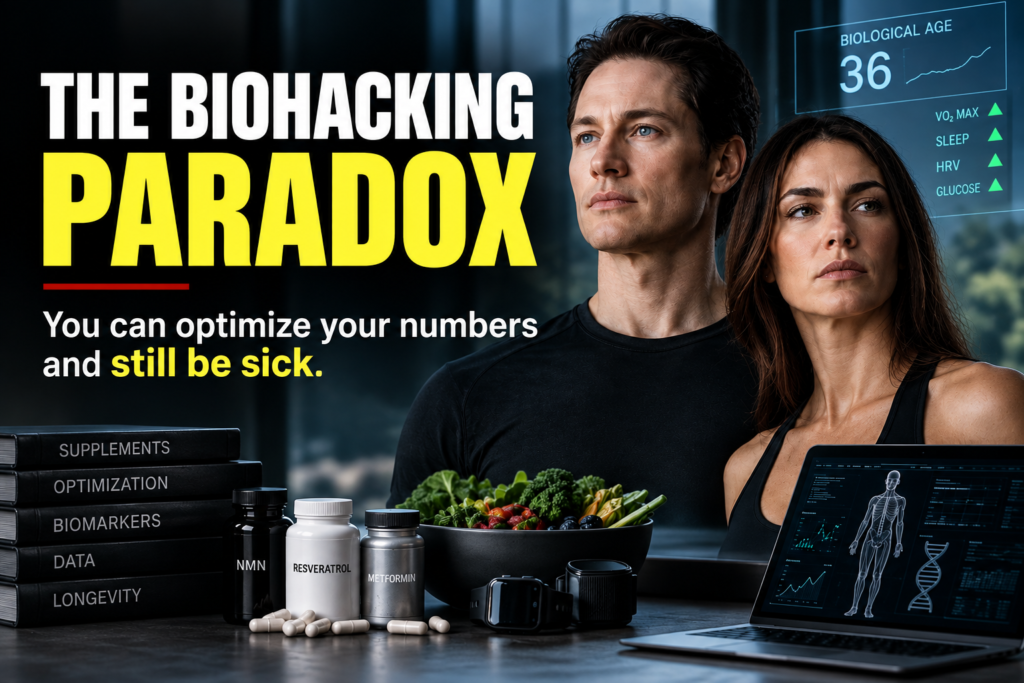
The Biohacking Paradox
There is something almost paradoxical happening here.
The more sophisticated our technology becomes, the more abnormalities we may discover.
And that’s not necessarily bad.
If advanced testing identifies disease earlier, wonderful.
If continuous monitoring identifies a dangerous trend, wonderful.
If a wearable motivates someone to exercise, sleep better, or lose unhealthy weight, I’m all for it.
Technology can be extremely useful.
But detection is not prevention, measurement is not healing, and optimization is not healthy longevity.
Those distinctions matter.
Kate’s case actually illustrates both sides beautifully.
Sophisticated testing helped confirm her endometriosis after years of suspected disease. That is potentially valuable.
But the technology that detected the disease didn’t prevent the disease from existing.
The same principle applies to Bryan.
His extraordinary measurements tell us an enormous amount about his body.
Yet his stomach biopsy revealed something his beautiful biomarker dashboard could not simply optimize away.
Maybe We Are Making Healthy Longevity Too Complicated
After nearly three decades of studying health and working with people, my philosophy has moved in almost the opposite direction.
I believe healthy longevity begins with fundamentals.
What are you eating?
What are you breathing?
How well is your digestive system functioning?
Are you physically active?
How much chronic stress are you carrying?
Are you addicted to nicotine, unhealthy foods, alcohol, cannabis, or other substances?
How are your thoughts affecting your behavior and your health?
These questions aren’t glamorous.
They don’t require artificial intelligence.
They don’t generate 1.5 billion data points.
But they apply to almost everyone.
I am not against technology.
I am against confusing technology with health.
And I am especially skeptical when we begin treating experimental longevity strategies as though their long term results have already been established.
They haven’t.
You Cannot Biohack Biology
I believe the Bryan Johnson and Kate Tolo story is valuable precisely because it forces us to confront the limitations of what we’re doing.
Their diagnoses do not prove that biohacking made them sick.
But they do remind us that even extraordinary measurement, discipline, money, technology, supplements, specialists, and optimization cannot guarantee freedom from chronic disease.
Perhaps future research will prove that some of today’s biohacking interventions dramatically extend healthy human life.
If that happens, I’ll welcome the evidence.
But we’re not there yet.
For now, I believe we should stop confusing better numbers with a guarantee of a better biological future.
Your body isn’t a computer.
Your biomarkers aren’t your entire biology.
And healthy longevity is not a spreadsheet.
You can measure biology.
You can influence biology.
You can support biology.
But you cannot outsmart biology.
That is why I wrote The 7 Fundamentals for Healthy Longevity.
The book isn’t about becoming the most measured human being on Earth. It’s about understanding the fundamentals that affect our health every day, from digestion and movement to our environment, stress, thoughts, and the way we live.
Because I believe the road to healthy longevity doesn’t begin with measuring thousands of numbers.
It begins with understanding and respecting the body you already have.
Discover The 7 Fundamentals for Healthy Longevity.