
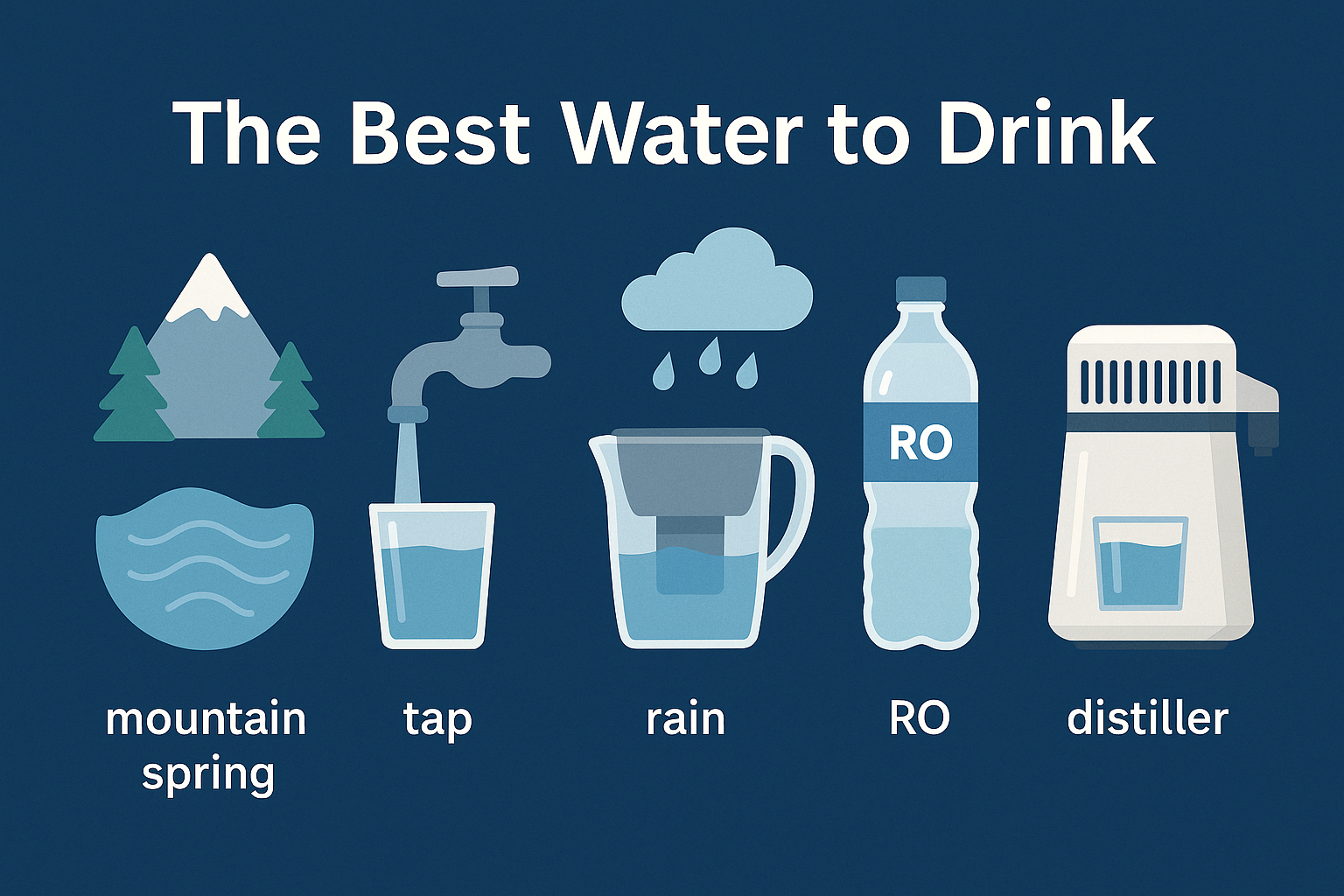



Once you understand how deeply water is woven into human biology, fueling circulation, temperature control, cell-to-cell communication, detoxification, and healing, another question naturally follows: what kind of water should I drink?
That might sound like splitting hairs (“water is water, right?”). Still, the quality and composition of your water shape how it tastes, how your body responds to it, how easily it hydrates you, and what long-term residues it may leave behind in pipes, appliances, and yes, your tissues. In modern life, we don’t all drink from a single village spring; we choose from tap, bottled, filtered, softened, reverse osmosis, distilled, rain-caught, or even melted snow. Each option carries trade-offs for safety, mineral balance, maintenance, environmental impact, and cost.
This guide walks you through the most common water types you’ll encounter, explaining how each is produced, what it removes (or leaves behind), the practical pros and cons, and how to make a smart, sustainable choice for everyday hydration. Along the way, you’ll also see simple ways to remineralize very pure water so it tastes better and works better with your body.
Quick note before we dive in: none of this is a substitute for local water testing or medical advice. If you live near agriculture or industry, or your home has older plumbing, test your water and take actions that fit your situation.
1) Hard water: mineral-heavy and appliance-unfriendly
What it is:
Water with a high concentration of inorganic minerals, primarily calcium and magnesium (with some sodium, iron, or manganese depending on the geology). Hardness comes from water percolating through limestone, chalk, or mineral-rich rock.
How you’ll notice it:
- White, chalky scale on kettles, faucets, and showerheads
- Soap doesn’t lather easily; “film” is left on skin or hair
- Water heaters and pipes scale up; appliances fail early
Health notes:
- Calcium and magnesium are essential minerals, but in hard water, they’re inorganic, not bonded to organic compounds like those in food. Your body doesn’t absorb these as efficiently.
- Over time and in susceptible people, excess inorganic mineral residue has been associated with things like kidney stones, arterial calcification, or joint stiffness. (It’s not “poison,” but it can be a burden if exposure is high and long-term.)
- Hard water can also aggravate skin conditions by reacting with soap and leaving residue that dries skin or triggers irritation.
Bottom line:
Hard water isn’t automatically unsafe to drink, but it’s not optimal for long-term hydration, is rough on plumbing, and can be irritating for skin and hair.
2) Soft water: naturally gentler, don’t confuse with “softened”
What it is:
Water with lower dissolved mineral content. This can be naturally soft (e.g., certain springs or surface waters) or artificially softened (ion-exchange systems that swap calcium/magnesium for sodium or potassium).
How to think about it:
- Naturally soft water often tastes light, “sweet,” and rinses clean. It tends to be friendlier to skin, hair, and appliances.
- Artificially softened water may feel silky and prevent scaling, but the added sodium/potassium can be an issue for people watching blood pressure or total sodium intake.
Measuring softness with TDS:
A TDS meter (Total Dissolved Solids) estimates dissolved particles (minerals/salts) in parts per million (ppm). Typical municipal tap runs 250–500 ppm. Above ~900 ppm is generally considered unsuitable for drinking. Distilled water reads ~0 ppm; naturally soft spring water often lands well under 200 ppm, depending on the source.
Bottom line:
Naturally soft water is generally a better daily drink than hard water cleaner taste, fewer residues. Just verify the source and any treatment steps.
A closer look at “spring” and “mineral” labels
“Spring water” in the U.S. must originate from an underground formation and flow to the surface, but companies may also bore into the aquifer, treat the water, or even blend it. The label doesn’t guarantee a pristine mountain trickle.
“Mineral water” must contain minerals, but the amounts vary wildly brand to brand; minerals may be natural or added. Either way, they are inorganic minerals, and their health value is modest compared with minerals from food.
Takeaway:
Don’t buy a story, research the brand (source, TDS, treatment, third-party testing) and taste. If it’s simply municipal water in plastic at a markup, you can do better at home.
3) Boiled water: essential in emergencies, limited in everyday life
What it does well:
Bringing water to a rolling boil for 1+ minute kills most bacteria, parasites, and many viruses. It’s indispensable during boil advisories, disasters, and backcountry travel.
What it doesn’t do:
Boiling doesn’t remove chemicals (e.g., chlorine, PFAS, pesticides, pharmaceuticals, nitrates, heavy metals). In fact, as water evaporates, it can concentrate whatever is left.
Taste/Practicality:
Boiled water can taste flat or chlorinous. It requires time, heat, and vessels, so it’s great as a backup, not a daily solution.
4) Rainwater: nature’s distillate… in a polluted atmosphere
Historically, rainwater was prized as pure. In principle, evaporation → condensation → precipitation leaves many contaminants behind. In practice, modern air contains sulfur/nitrogen oxides, soot, heavy metals, pesticides, and microplastics. As raindrops fall, they pick up what’s in the air and on surfaces (roofs, gutters).
Safer use:
- In water-scarce regions, harvested rain can help, but it should be filtered, disinfected, and tested before drinking.
- For gardens, washing, or flushing, it’s often fine.
5) Snow water: beautiful, but no longer reliably “pure”
Fresh snow looks like frozen purity, yet research finds microplastics, industrial residues, and microbes even in remote regions. Melting snow can be a lifesaver in emergencies, but for routine drinking, it should be boiled/treated, and it’s not a dependable everyday source.
6) Filtered water: helpful, but only as good as the filter (and your maintenance)
How it works:
Water passes through mechanical, chemical, or adsorption media (e.g., activated carbon, ceramic, or ion-exchange). Some systems add UV or ozone for disinfection.
Strengths:
- Improves taste/odor by removing chlorine and organic compounds
- Reduces sediment, rust, some VOCs, and, in some designs, lead, cysts, or certain pesticides
Weaknesses:
- Not all filters remove everything – viruses, PFAS, nitrates, dissolved metals, and many pharmaceuticals can slip through, depending on the cartridge
- Maintenance matters: old filters become microbe hotels and can release what they trapped; biofilm can build up
Best practices:
- Read the NSF/ANSI certifications (what exactly does this filter remove?)
- Replace on schedule; sanitize housings when you change cartridges
- Consider multistage designs (sediment + carbon + UV, etc.)
Bottom line:
Filtration is a good step, not the whole plan. Choose the right filter for your contaminants and maintain it religiously.
7) Reverse osmosis (RO): high-purity at home with caveats
How it works:
Water is pushed through a semipermeable membrane that rejects most dissolved solids. Typical RO removes ~90–97% of minerals and >99% of many particles and microbes.
Why people love it:
- Very clean taste
- Powerful reduction of heavy metals, nitrates, fluoride, and many chemicals
- Reliable when the source water is questionable
Trade-offs:
- Wastewater: classic systems can waste 4–6 gallons per gallon produced; newer designs cut this to ~2:1 or better
- Clogs in hard water unless you have pre-filtration
- Maintenance (prefilters, postfilters, membranes) required
- Produces demineralized water (great for purity; some prefer to remineralize for taste/feel)
Bottom line:
One of the most effective household options. Pair it with remineralization and keep up with maintenance; choose a high-efficiency model if you’re water-conscious.
8) Deionized (DI) water: excellent for labs and industry, not for daily drinking
How it works:
Ion-exchange resins swap out mineral ions (e.g., calcium, magnesium, iron) for hydrogen/sodium ions, stripping hardness.
Limitations for drinking:
- DI removes mineral ions but not many organic chemicals, microbes, PFAS, pharmaceuticals, etc.
- Often tastes flat or slightly acidic/salty.
- Long-term exclusive use is not ideal for electrolyte balance.
Where it shines:
Electronics, pharmaceuticals, and hospital sterilization are places where minerals would interfere.
9) Distilled water: near-total purity, plus a smart way to remineralize it
How it’s made:
Water is boiled; steam rises, leaving behind nearly all solutes (minerals, metals, microbes, many chemicals), then condenses back to liquid. It mimics the natural water cycle and produces very low TDS water.
Why do some people choose it:
- Consistency and purity, you know what’s not in it
- Useful for detox protocols (with professional guidance)
- Reduces reliance on bottled water if you distill at home
Common concern: “Does it strip minerals from your body?”
- Distilled water does not leach minerals from inside your cells; your meaningful mineral intake comes from food, not water.
- Very pure water can help flush unused inorganic residues, which is different from losing cellular nutrients.
- If your diet is weak in magnesium, calcium, potassium, etc., fix the diet or remineralize your water for taste and comfort.
Long-term use:
Widely considered safe when you eat a mineral-sufficient diet. If you prefer the mouthfeel and buffering of minerals in water, remineralize it (details below).
Comparing water types at a glance
- Hard water: Durable minerals, scale, tough on skin/hair; not toxic, but not optimal.
- Naturally soft water/quality spring water: Pleasant, gentle; verify source and treatment.
- Boiled water: Excellent for microbes, not chemicals; emergency-ready.
- Rain/snow: Reflect air pollution; treat/test before drinking.
- Basic filtration: Taste upgrade; targeted removal if properly matched and maintained.
- Reverse osmosis: High purity; mind the wastewater and consider remineralization.
- Deionized: For labs/equipment, not for daily hydration.
- Distilled: Highest household purity; remineralize if desired.
Remineralizing very pure water (RO or distilled): easy, precise methods
Very pure water can taste “flat.” Adding a small, measured amount of minerals restores a spring-like profile and supports comfortable hydration.
Option A: Trace mineral drops (most precise)
- Use a reputable concentrated trace mineral solution (often derived from seawater).
- Follow the label; typical dose is a few drops per glass or 10–20 drops per liter.
- Pros: precise, consistent, broad trace spectrum. Cons: ongoing purchase.
Option B: Unrefined salts (simple and economical)
Unrefined sea salt or Himalayan salt contains dozens of trace minerals beyond sodium.
- Standard home guideline: add ¼ teaspoon of Himalayan or Celtic sea salt to 1 gallon (3.8 L) of distilled/RO water.
- For a lighter touch, some use ⅛ teaspoon per gallon.
- This adds small amounts of magnesium, potassium, calcium, and trace elements, improving taste without making water “salty.”
Choose clarity over confusion
Water decisions don’t need to be overwhelming. Start with knowledge of your source (test reports), pick a method that matches your needs, and commit to simple maintenance. The goal isn’t to chase a perfect myth of purity; it’s to drink clean, great-tasting water every day without burdening your body or the planet.
Whether you land on a well-maintained filter, a high-efficiency RO with a gentle mineral finish, or a distiller paired with a pinch of sea salt, you’ll have done something powerful: you’ve taken control of the single most important input your body receives. Hydration stops being a guess and becomes a daily act of support for your brain, heart, joints, and cells.
Raise a glass to clarity, consistency, and vitality in every sip.