
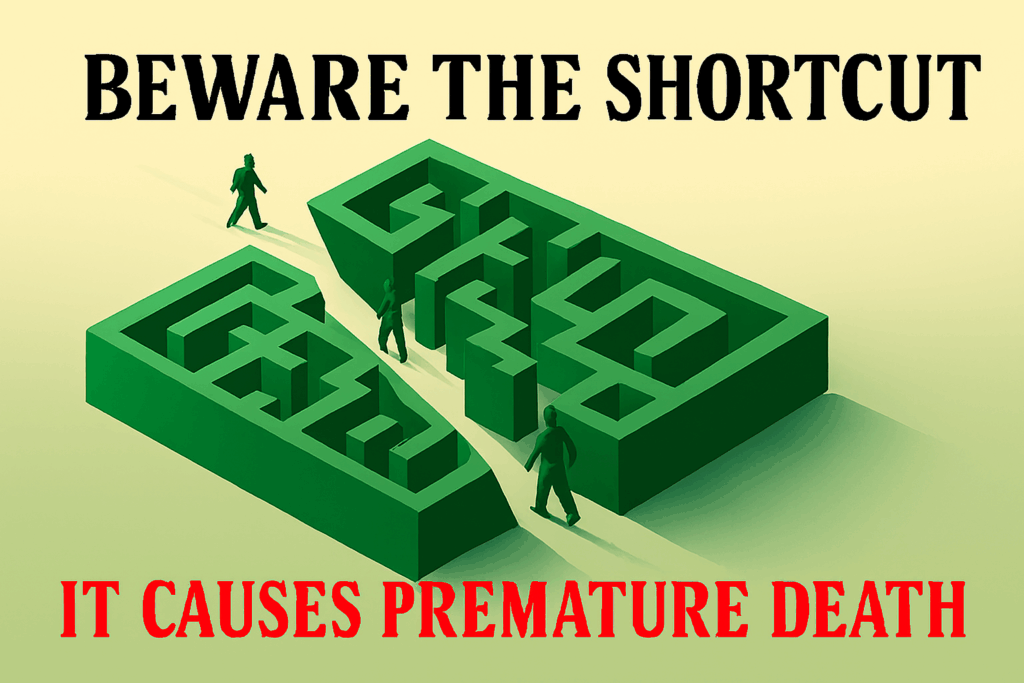

In the past 100 years, technology has given us many ways to make life easier. I call them shortcuts to pleasure and happiness. Yet, some of these shortcuts have turned addictive, leaving many people chronically sick and dying prematurely.
Since the first industrial revolution 200 years ago, humans have developed new ways to protect the survival of our genome. This survival mechanism is rooted in the DNA of all species; otherwise, they would not exist. At the foundation of life are three fundamentals of survival: first, to seek pleasure, mainly from food and sex. Second, to avoid pain and suffering, and third, to save energy.
Because humans are different from other species in instincts, thoughts, feelings, and behaviors, our expression of pleasure is much more complex. That is why we find pleasure not only in food and sex but in countless other areas of life.
Machines replaced slaves, hard labor became easier, and even household work became lighter than in the past. As a result, women who gained free time were able to join the workforce. In the free world, when you have a job and money in your hand, you can buy pleasures, and in modern times, you can do so while saving time and energy. You can pursue your dreams with less pain and less suffering. Today, you can do things your grandparents or even your parents never could.
Hallelujah, is that not what freedom is all about?
However, there is a catch. The population pays a heavy health price for these shortcuts in life. Science recognizes a sedentary lifestyle as a major contributor to chronic diseases. That is why we now see health and fitness clubs spreading worldwide, with over 200 million active members and nearly 100 billion dollars in annual profit. Yet, despite this, people are getting sicker, physically, emotionally, and spiritually. This is because the three fundamentals of our survival have been dramatically altered in the modern age.
Today, technology and emergency medicine help us avoid pain and survive crises. But the most essential foundation of survival, the pursuit of pleasure through food and sex, has completely changed. In my research, I have found this transformation to be the root cause of most chronic physical and mental diseases. Let us take a closer look at how this happens.
How Pleasure Turned Into Addiction
In order to survive, humans once had to build shelter, hunt, and grow food. The head of the family or the tribe knew that survival required many working hands. Throughout history, each member of the community had a role. At sixteen, boys became men and joined the workforce or the army to protect the tribe in times of war. Girls, at fourteen, became women. Along with their daily work, they were expected to bear children and grow the community. Women had little choice in marriage or in how many children to raise. Mortality among young children was high due to poor sanitation and lack of hygiene, which is why polygamy was widely practiced, and in some places still is.
By the 19th and 20th centuries, people moved into larger cities for jobs and better living conditions. As child mortality dropped, families had fewer children. With this shift, women had more freedom to choose their partners and the number of children they wanted. By the mid-20th century, the sexual revolution and feminist movement reshaped the role of women. With the arrival of birth control, sex for pleasure became available everywhere. Later, the digital revolution transformed sexual behavior completely. The rise of online pornography, now a 100 billion dollar industry, clearly shows that sexual activity is shifting from physical to virtual.
Only fifty years ago, a man had to court a woman, take her to dinner, and make an effort to impress her before she agreed to intimacy. Today, pleasure can be achieved instantly without spending time, money, or energy. Social media made relationships increasingly virtual, and recent social distancing only deepened the shift. People now experience more stress, more anxiety, and more loneliness, and addictions are increasing in response.
Food has also undergone a profound transformation. For thousands of years, people ate what they could grow, gather, or hunt, based on the season and their environment. Meals took hours to prepare, often requiring the labor of the family members. After World War II, the modern food industry reshaped this pattern. Processed foods were designed not just for convenience but to appeal to taste buds in ways that make them addictive. These foods are easy to prepare, last a long time on the shelf, and are cheaper than fresh food. But the results are devastating.
Today, 70 percent of Americans show their food addiction through being overweight or obese. These conditions are now leading causes of chronic disease and premature death. Many people who are overweight or obese feel unattractive, isolated, and depressed. Is it surprising that the pornography industry thrives when so many feel unwanted and lonely? Not long ago, smoking was the leading cause of premature death. Today, obesity has surpassed it. Addiction has become the shortcut to pleasure, promising quick satisfaction while quietly eroding health and life.
Breaking Free From the Cycle
In my clinics, many smokers and overweight people came seeking alternative solutions for blood pressure, cholesterol, diabetes, and other chronic illnesses. With most of them, I refused to begin treatment, because it is impossible to heal chronic disease while someone continues to cling to the addiction that caused it.
In 2009, I relapsed into old addictions, smoking and fattening foods. This time, I felt close to death. My heart disease symptoms grew worse, and my cardiologist advised me to begin medication. It took me eight long years of trial and error to finally discover the escape path. On February 9th, 2016, I broke free from addiction to nicotine and fattening foods. Since that day, I know there is no way back. I have the tools to protect myself permanently, and I live free from the grip of those addictions.
If you are dealing with chronic disease and struggling with addiction to fattening foods, nicotine, or alcohol, there is a way forward. You can learn what causes your addiction, why quitting feels impossible, why relapses happen, and how to overcome them step by step. Your journey to freedom begins when you learn how to release destructive habits and adopt new ones. With practice, you can claim your freedom and disconnect from addiction, this time for good.
The choice is in your hands. You can click the link below to start your path to freedom. Do it now. You owe it to yourself and your family.
Take the first step now.