
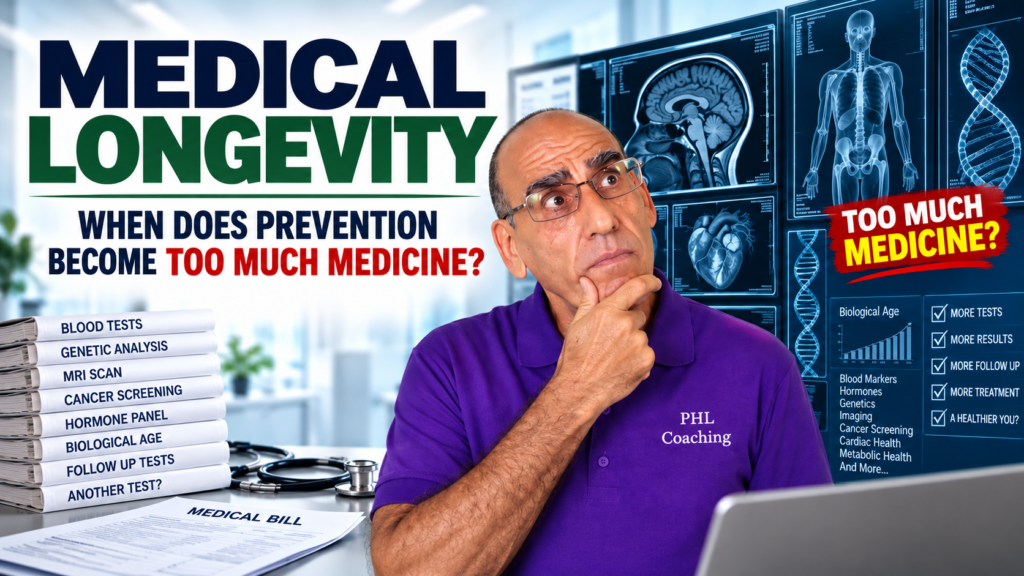



More testing promises earlier detection and longer health, but could it also create more anxiety, more treatment, and a lifetime of being a patient?
For most of modern medicine, the system has worked in a familiar way.
You develop symptoms. You visit a doctor. Tests are performed. A disease is diagnosed. Treatment begins.
Medical longevity wants to change that sequence.
Instead of waiting for cardiovascular disease, diabetes, cancer, or neurodegenerative disease to become clinically apparent, longevity medicine attempts to identify risks much earlier and intervene before disease takes hold.
On the surface, that sounds wonderful.
Who wouldn’t rather prevent disease than treat it?
I certainly believe in prevention. But when I look at where medical longevity is heading, I see several questions that deserve much more attention.
Can ordinary people afford it?
Does more testing actually produce longer, healthier lives?
And perhaps most importantly:
Can constantly searching for disease eventually turn a healthy person into a frightened patient?
What Is Medical Longevity?
Medical longevity is built around extending healthspan, the years we remain healthy and functional, rather than simply increasing the number of years we’re alive.
That’s an important distinction.
Nobody dreams of reaching 100 while spending the last 20 years sick, disabled, and dependent on others.
The goal should be reaching our later years physically capable, mentally sharp, independent, and relatively free from chronic disease.
Modern longevity medicine may use advanced blood panels, metabolic testing, ApoB, hormone testing, genetic analysis, continuous glucose monitoring, coronary artery calcium scans, full-body MRI, cancer screening technologies, biological age tests, wearables, and other tools.
Some of these are established medical tools.
Others are much newer.
And some are being marketed faster than the evidence supporting their use in healthy individuals.
Is Medical Longevity Becoming a Luxury?
Here’s the first problem.
Many advanced longevity services aren’t covered by conventional health insurance.
Concierge physicians, extensive laboratory panels, genetic testing, advanced imaging, biological age testing, wearables, and repeated consultations can easily cost thousands of dollars.
Go far enough, and the price becomes much higher.
That creates an uncomfortable contradiction.
If medical longevity becomes one of our answers to chronic disease but comprehensive longevity medicine is affordable mainly to wealthy people, we haven’t created a public health solution. We’ve created premium prevention.
The average 50-year-old worrying about housing, insurance, food, children, and retirement probably isn’t going to spend thousands every year discovering whether his biological age is 47 or 53.
But there’s another question.
Should he?
More Testing Does Not Automatically Mean Better Health
We tend to assume that finding disease earlier must always be better.
Sometimes it absolutely is.
Finding hypertension before a stroke can save a life. Identifying diabetes early can prevent complications. Appropriate cancer screening can discover certain cancers at more treatable stages.
But early detection isn’t automatically beneficial simply because it is early.
There is an important medical concept called overdiagnosis.
Overdiagnosis doesn’t necessarily mean the diagnosis is incorrect. It can mean detecting a genuine abnormality that would never have caused symptoms or shortened that person’s life.
Then comes another possibility, overtreatment.
Finding something earlier can lead to intervention earlier. Sometimes that intervention is lifesaving. Other times it may mean years or decades of medication, procedures, monitoring, side effects, interactions, and additional testing without enough corresponding benefit.
That’s not automatically healthier longevity.
The American College of Radiology, for example, says there isn’t sufficient evidence to recommend total body MRI screening for people without symptoms, risk factors, or relevant family history. It also warns that nonspecific findings can trigger additional procedures and expenses without necessarily improving health.
That should make us think.
Just because we can look doesn’t mean we should always look.
What Happens When a Test Finds Something?
Imagine you’re 55.
You feel great.
You exercise.
You don’t smoke.
You eat reasonably well.
You have no symptoms.
Then you purchase an extensive longevity evaluation.
One blood marker comes back abnormal.
“It’s probably nothing. Let’s repeat it.”
Now you’re thinking about it.
The next test is still slightly abnormal.
Another test follows.
An MRI discovers something.
The radiologist believes it’s probably benign but recommends another scan in six months.
Suddenly, something fundamental has changed.
Yesterday you considered yourself healthy.
Today you’re waiting to discover what might be wrong with you.
Some incidental findings genuinely save lives.
Others begin cascades of additional scans, specialist appointments, biopsies, expenses, anxiety, and sometimes treatments for abnormalities that might never have harmed the person.
This raises a question that isn’t discussed enough:
Can you test yourself into becoming a patient?
And There Is a Financial Question
We shouldn’t pretend economics doesn’t exist.
Tests generate revenue.
Imaging generates revenue.
Specialist consultations generate revenue.
Procedures generate revenue.
Prescriptions generate revenue.
Follow-up visits generate revenue.
That does not prove doctors or longevity clinics are deliberately creating patients for profit.
But it does create a legitimate question about incentives.
If millions of healthy people begin repeatedly searching their bodies for abnormalities, the result could be an enormously profitable medical ecosystem.
More testing can discover more abnormalities.
More abnormalities can produce more follow-up.
Some lead to treatment.
Some treatments continue for years.
So we should be willing to ask:
Do the financial incentives of medical longevity always align perfectly to keep healthy people healthy?
Earlier Treatment Can Also Mean Longer Treatment
There is another side to early detection that deserves attention.
Suppose a condition is discovered ten years earlier than it would have been previously.
If treatment prevents a heart attack, stroke, cancer death, or disability, those additional years of treatment may be extraordinarily worthwhile.
But if the benefit of treating that particular abnormality is uncertain, earlier diagnosis could simply mean becoming a medical patient ten years earlier.
If medication is involved, it may also mean ten additional years of exposure to potential side effects and drug interactions.
As people age, medication burden becomes particularly relevant. Polypharmacy is associated with concerns including adverse drug events, drug interactions, falls, cognitive effects, and treatment burden, although necessary medications can obviously provide substantial benefits.
This is why early intervention cannot automatically be equated with longevity.
The relevant question isn’t:
How early can we treat something?
It’s:
Will treating it earlier meaningfully improve this person’s future?
Relative Risk Can Make Healthy People Feel Sick
Numbers can also frighten people when they aren’t properly explained.
Suppose you’re told a biomarker is associated with a 50% greater risk of a disease.
That sounds terrifying.
But imagine your underlying risk were 2%.
A 50% relative increase would raise that risk to approximately 3%.
That’s an increase of one percentage point in absolute terms.
Both numbers matter.
But they don’t sound remotely the same.
As longevity medicine generates more predictions about future disease, patients need to understand absolute risk, not simply dramatic relative percentages.
Otherwise, a healthy person can leave a longevity clinic believing disaster is approaching when their actual individual risk remains relatively small.
What About Your “Biological Age”?
Perhaps no idea represents modern longevity medicine better than biological age.
Imagine being 60 and receiving a report saying:
Biological age: 67.
How would you feel?
Would you become motivated?
Or frightened?
Would you exercise more?
Change your diet?
Buy supplements?
Order another test six months later?
Researchers have raised serious concerns about using current epigenetic clocks for individual medical decisions. A 2025 scientific analysis concluded that these tools do not currently meet ordinary standards for individual clinical utility and warned that personal use can be uninformative and potentially harmful.
That doesn’t make aging research useless.
It means something very different:
A fascinating research measurement isn’t automatically a useful personal medical measurement.
Can Longevity Become a Source of Chronic Stress?
Now imagine repeating dozens of these measurements every year.
Glucose.
Insulin.
ApoB.
Inflammatory markers.
Hormones.
Micronutrients.
Cancer markers.
Genetics.
Heart imaging.
Body composition.
Sleep.
Continuous glucose.
Biological age.
MRI.
Then repeat.
You started this journey because you wanted to live longer.
But now you’re constantly wondering what the next test will find.
That’s the paradox.
At what point does trying to prevent future disease begin damaging your ability to enjoy being healthy today?
Chronic anxiety isn’t my definition of healthy longevity.
Before Testing Everything, Look at Your Life
This brings me back to the philosophy behind The 7 Fundamentals for Healthy Longevity.
Before spending thousands of dollars searching for invisible problems, start with the problems you can already see.
Do you smoke?
How much alcohol do you drink?
What do you eat?
Are you physically active?
How well do you sleep?
How is your digestion?
What kind of air are you breathing?
How much chronic stress are you carrying?
Are you addicted to nicotine, fattening foods, alcohol, or other substances?
You don’t need a $5,000 longevity package to answer those questions.
But changing the answers can be much harder than ordering another test.
Testing is easy. Changing behavior is hard.
You can buy an MRI tomorrow.
Breaking a 30-year nicotine addiction is another matter.
You can put on a continuous glucose monitor.
Changing decades of unhealthy eating habits is much harder.
You can measure sleep every night.
Removing the stress that keeps you awake may require changing your life.
Perhaps we’re becoming fascinated by everything medicine can measure while ignoring what we already know we need to change.
Medical Longevity Has a Place
I’m not against medical longevity.
Quite the opposite.
Better risk assessment, earlier detection, personalized prevention, and new diagnostic technologies may transform medicine.
But more medicine isn’t automatically better medicine.
Every longevity test should eventually answer three basic questions:
Can we trust the information?
Will the result change what we should do?
And does acting on it improve health enough to justify the financial, physical, and psychological costs?
If the answers are yes, that’s valuable medicine.
If the only answer is, “Because now we can measure it,” that’s not enough.
The purpose of longevity shouldn’t be spending the second half of your life searching for the disease that might eventually kill you.
It should be spending those years building and enjoying health.
The goal isn’t to become the most tested person in the room.
The goal is to become the healthiest older person you can reasonably become.
And that’s why I believe the fundamentals should come before the technology.