
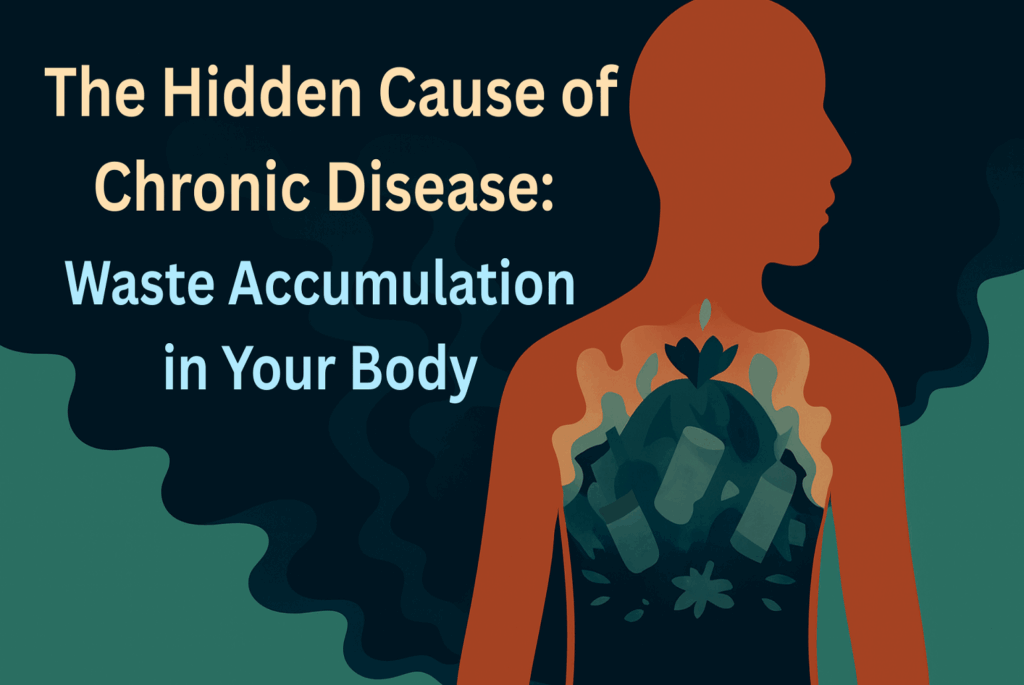


Many of my customers, usually in their 50s and 60s, often ask me why they became chronically ill in the second half of their lives. My answer has always been the same, regardless of the specific condition: it is most likely the result of waste accumulating in the body.
It is vitally important to understand how waste accumulates within us and how this accumulation contributes to chronic disease. To clarify, I will outline some of the primary reasons behind this accumulation.
The Body as an Ecosystem
Science has discovered that the human body contains more than 30 trillion cells, but we are not just made up of human cells. We also host countless species of bacteria, many of which science is still trying to fully understand. These tiny organisms feed on the food we eat, but they also play a protective role, helping us survive in the challenging environment we live in.
To grasp how the body functions, we need to think of it as a perfect ecosystem powered by air, water, food, and waste elimination. The laws of nature apply to our bodies just as they do to every living creature. One of the most basic natural laws is the law of nutrition, which states: if something is alive, it must be fed, and if it feeds, it must produce waste. This is true of bacteria, viruses, birds, fish, reptiles, and mammals, all forms of life.
Modern Sources of Waste
Now consider what many of us consume daily: liquids enriched with artificial chemicals, food stripped of natural nutrients, medications, and industrialized supplements full of synthetic compounds. All of these contribute to waste buildup in the body.
Just 100 years ago, people did not deal with this kind of constant exposure to chemical impurities. Their diets and lifestyles were much closer to nature. Today, we live in a world where what we eat and drink is often highly processed and unnatural, and the consequences of that are reflected in our health.
Pollution in Nature, Pollution in the Body
The accumulation of waste inside the human body mirrors the way we have polluted our natural environment. After World War II, throughout the 1950s, 60s, 70s, and 80s, industrial progress exploded, but so did environmental pollution. At the time, many believed that nature would absorb our pollution without consequences. We now know that was naive. Decades of industrial waste damaged the ozone layer, which was supposed to shield us.
I saw a smaller, but striking, example of this when I lived in Michigan. Before the 1960s, many lakes were surrounded by small cabins where families from Detroit would spend their summers and winters. Starting in the 70s and 80s, those cabins were replaced by larger houses with manicured lawns, motorboats, and jet skis.
The result was year-round habitation and more pollution. Fertilizers, pesticides, and chemicals from septic tanks began seeping into the lakes, damaging the ecosystem. What had once been a healthy, balanced, natural system became contaminated.
The same thing happens inside the human body. When we pollute ourselves year after year with the food we eat, the water we drink, the air we breathe, and the chemicals we take in, waste accumulates. Eventually, the body or a specific organ reaches its breaking point. That is when we experience symptoms of disease.
The Role of Thoughts and Emotions
Waste does not only come from liquids, food, and chemicals. It also comes from our thoughts. It is normal to have both positive and negative thoughts, but for many of us, the negative outweighs the positive. We judge ourselves harshly, criticize others, and feed on anger and resentment. It is often easier to hate than to love, and we seek satisfaction by buying things rather than creating joy from within.
This emotional pollution lowers our immunity. Combined with physical waste, it sets the stage for chronic and sometimes incurable disease.
Where Waste Accumulates
Waste does not accumulate in just one place. It collects throughout the body:
- What we breathe affects the lungs and our overall well-being.
- What we drink affects the kidneys, liver, heart, and blood.
- What we eat, along with the medicines and supplements we take, affects the digestive system, heart, liver, spleen, pancreas, brain, and blood.
At its root, disease is a blockage of energy. When the flow of energy in and out of the cells, tissues, organs, and systems is interrupted, problems arise. Each of us has weaker organs or systems, and those are the ones most vulnerable to disease.
Acute disease first appears in the organ most affected. If we do not restore the flow of energy, the acute condition repeats until it eventually becomes chronic.
The Problem With Medications
At that point, the doctor offers what is called a “miracle drug,” one that removes the symptoms but does not cure the disease. These medications are designed to make life more manageable, but they do not address the underlying problem. In fact, they often make it worse by allowing people to continue the same lifestyle that caused the condition in the first place.
Every medication is, in essence, a poison. That is why pharmaceutical companies are required to include warning labels and side effects with every prescription. Notice how most of these side effects involve organs of elimination, the liver, kidneys, skin, and digestive system.
The Two Main Causes of Chronic Disease
Now that you understand how acute and chronic diseases develop, let me be clear. There are only two main causes behind the formation of chronic disease:
- The accumulation of physical waste from what we eat, drink, breathe, and consume as medicine.
- The accumulation of emotional waste from unresolved negative thoughts and feelings.
Together, these destroy balance in the body and lead to chronic illness.
Want to enjoy healthier, more vibrant golden years? Now is the perfect time to discover the seven fundamentals of healthy longevity. Explore them today and see how simple steps can transform your future. [Click here]